

Search
Or hit enter to search
By Owen Gow, Deputy Director, Extreme Heat Initiative, Atlantic Council’s Climate Resilience Center, Washington, DC
Despite the escalating impacts of climate change, including longer, more frequent and severe heatwaves, only a fraction of total climate change-related financial flows go toward climate adaptation. Recent estimates suggest spending on climate adaptation comprises only 5% of total climate finance, and the adaptation gap remains as high as USD$359 billion. Investment specific to extreme heat, the deadliest climate hazard, is yet to be quantified but is likely a small proportion of adaptation finance.
Numbers on a balance sheet fail to capture the human lives affected by investment decisions. The reality is that additional dollars spent on adaptation could help a tired worker sleep comfortably in their home at night, or alert a family ahead of a life-threatening heatwave. And the good news is that opportunities exist for both improving human health outcomes and making economies more resilient in a warming world.
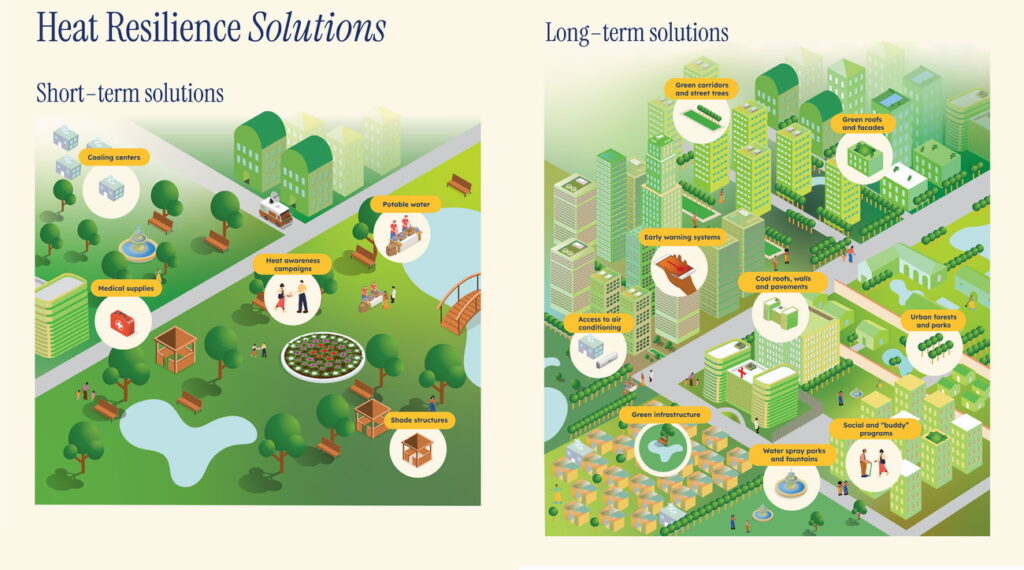
The first priority should be saving lives and reducing chronic illnesses among communities most likely to suffer the worst consequences of heatwaves. Local governments and philanthropies should act swiftly to invest in protective measures like community-level cooling infrastructure and heat early warning systems.
Next, governments and industry must incorporate heat-related considerations into large-scale public infrastructure projects to ensure that they are reliable and cost-effective over the mid- to long-term. How might rail lines buckle under the temperatures predicted 10 years from now? How can shade canopies and building design specifications deliver public spaces that are both walkable and improve business continuity during hot days?
| Governments must act with foresight—investing now in equitable, scalable solutions to avoid escalating economic and human costs of extreme heat. |
Insurance markets are struggling to adapt to the ever-increasing levels of risk posed by climate change. The way forward is supplementing widespread heat preparedness measures with risk transfer tools such as parametric heat insurance. This accounts for worst-case scenarios by providing a quick post-event payout to assist with recovery, and in the coming years, might pay out ahead of heatwaves.
Finally, national governments should direct research funds toward the research and design of new heat adaptation technologies. From hyper-efficient air conditioners and wearable tech like “cooling patches” to the technologies that are yet to be imagined, societies will increasingly turn toward advancements in science to bridge the gap between the magnitude of heatwave exposure and the limits of human physiology to maintain not just safety, but thermal comfort.
Governments may be loathe to prioritise heat adaptation against the constellation of other risks and expenses managed by the state. But the reality is that heat is already costing us. Reduced labour productivity, increased healthcare costs, and infrastructure damage are just a few examples of how people and economies are absorbing these costs into their daily lives. In some cases, the prices of heat-adaptive products are becoming competitive with the status quo alternative. The mid- to long-term savings from lower temperatures may become just an added bonus.
In order to mobilise economy-wide changes in infrastructure, preparedness, and resilience, private finance will need to be mobilised toward heat adaptation. As seen in the case of the Inflation Reduction Act in the United States, accelerating the domestic solar market, governments can play a decisive role in expanding markets for new or underutilised technologies. The question today is whether governments will have the foresight to act now, before the next heatwave strikes.
Disclaimer: The views expressed in this piece are those of the author/s and do not necessarily reflect the views or policies of AIDMI.
