

Search
Or hit enter to search
By Pallavi Rathod, AIDMI, India
In the extreme heat of Ahmedabad’s summer, small businesses struggle not only for profit but for survival. For Ramilaben Rameshbhai Patani, a vegetable seller from Laxminagar, Naroda, this struggle is deeply personal.
Abandoned by her husband over 20 years ago, Ramilaben has single-handedly sustained her family by selling vegetables from a street cart. But recent years have seen this modest livelihood threatened by rising temperatures. As extreme heat events become more frequent and intense, women like Ramilaben—small businesses and sole earners—are disproportionately affected.
During a field assessment by the All India Disaster Mitigation Institute (AIDMI) on the impact of extreme heat on small businesses, Ramilaben shared how the sweltering conditions were undermining both her health and her income. In peak summer months, she loses ₹2,000 to ₹3,000 to vegetable spoilage alone. One incident last year proved especially harrowing: Ramilaben suffered a heatstroke, requiring hospitalisation, medical expenses, and four days of missed income. Tire damage to her cart and mounting debt from high-interest loans further strained her fragile financial balance.
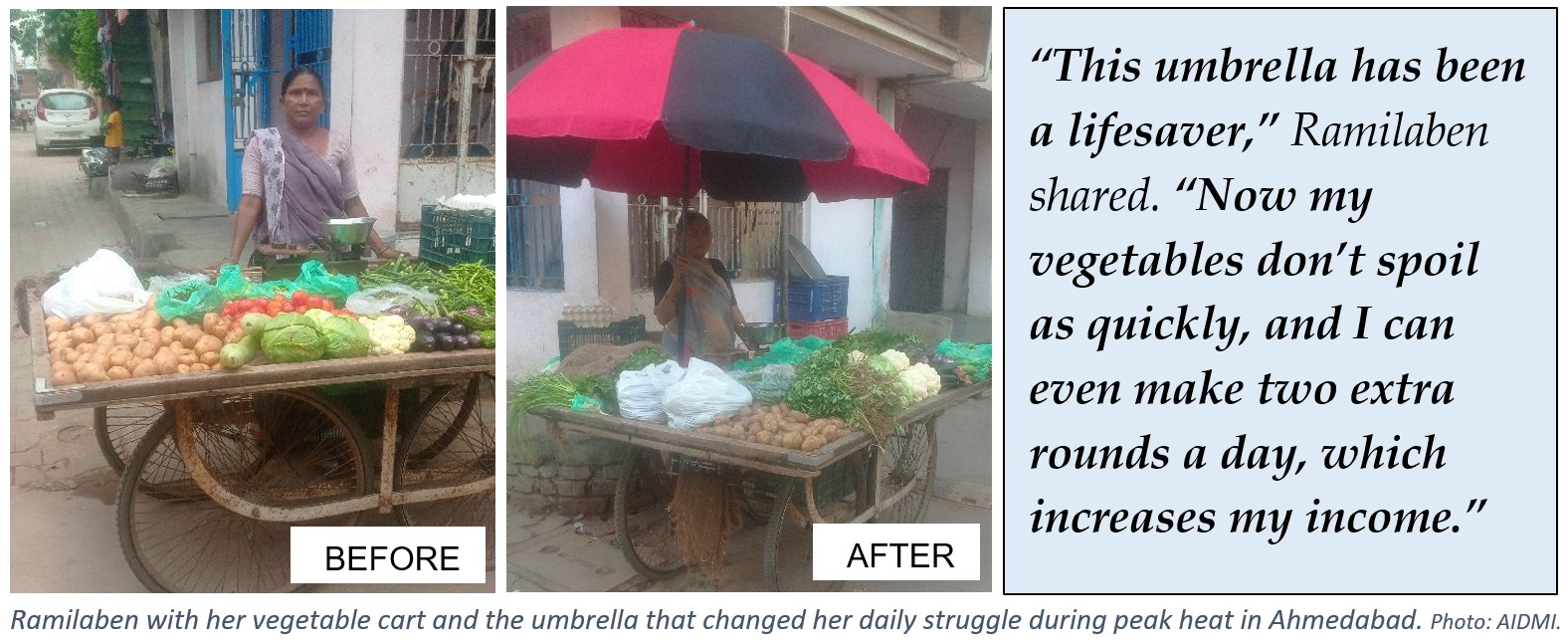
Recognising the urgent need for local, practical interventions, AIDMI stepped in to support Ramilaben. She received assistance that helped her install a large protective umbrella on her cart, repair critical parts of the vehicle, and partially repay debt. This modest support produced a measurable impact—reducing vegetable spoilage, increasing daily productivity, and most importantly, shielding her from the direct heat.
Ramilaben also participated in a heat safety training conducted by AIDMI, where she learned, for the first time, about the health risks of extreme heat and the protective measures she could take. What was once considered a “normal” part of summer—frequent illness and exhaustion—was reframed as a preventable climate hazard.
“Earlier, we didn’t take heat seriously,” she said. “But the training opened our eyes. Now I know that with some precautions, I can stay healthy and continue working.”
Her story reflects the urgent need to address extreme heat not just as an environmental challenge, but as a humanitarian and livelihood crisis. It also highlights the transformative potential of small, targeted interventions, especially when paired with education and capacity building.
Ramilaben’s closing words are a call to action:
“This is the first time any organisation has worked for people like us to protect us from the extreme heat. I hope others like me can also benefit from this.”
As cities like Ahmedabad face more frequent and deadly heatwaves, the resilience of small businesses—especially women-led—will depend on scalable solutions rooted in local needs, empathy, and innovation.
