

Search
Or hit enter to search
By Prajakta Pimpalshende, and Shalini Dhyani, CSIR-National Environmental Engineering Research Institute (NEERI), Maharashtra; Academy of Scientific and Innovative Research (AcSIR), Uttar Pradesh, India
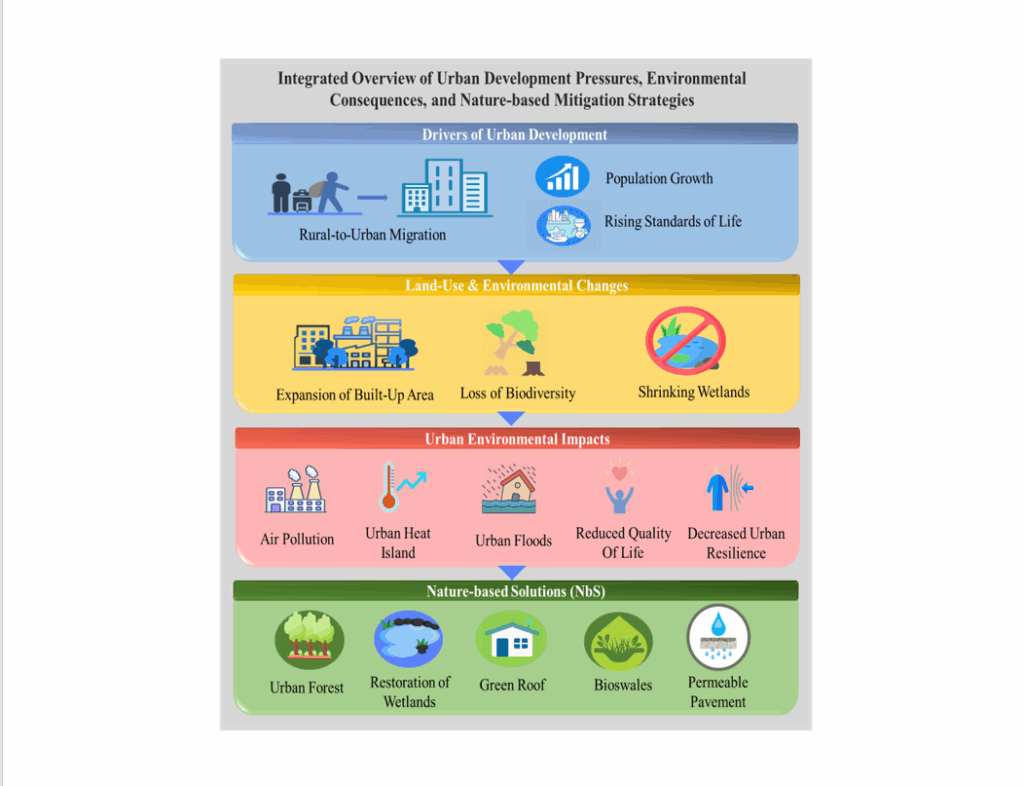
Urbanisation in Indian cities is accelerating rapidly, often at the cost of environmental sustainability and public well-being. The city of Nagpur is an example of this urban transformation. The city’s ongoing expansion poses significant threats to its natural ecosystems, giving rise to challenges such as Urban Heat Islands (UHI), flash floods, and the degradation of urban Blue-Green Infrastructure (BGI) (Dhyani et al., 2018). The unregulated development of Nagpur’s peripheral zones has led to the encroachment upon natural buffers, critical green spaces, and wetlands (Dhyani et al., 2018). This, combined with the unplanned cutting of trees for infrastructure projects such as road widening or utility installation, has intensified the UHI effect, especially during the city’s already harsh summers (Dhyani et al., 2018). Despite these challenges, existing urban forest patches, such as those within the NEERI and VNIT campuses, have consistently recorded temperatures nearly 3°C lower than surrounding built-up areas, highlighting their importance in microclimate regulation and contributing to carbon sequestration (Dhyani et al., 2018, 2021). In light of these findings, Nature-based Solutions (NbS), particularly BGI, are increasingly recognised as essential strategies for climate adaptation in cities (Dhyani et al., 2021; Shukla, Pophali, et al., 2024).
Wetlands play a significant yet often overlooked role in urban ecology. Shukla, Pophali, et al., (2024) reported a drastic decline in the structure and function of several wetlands in Nagpur over the last two decades. These ecosystems serve as natural flood buffers and contribute to the regulation of ambient temperature. Their loss highlights the city’s vulnerability to flash floods, particularly during extreme rainfall events. A blue-green buffer strategy that incorporates community knowledge and restoration efforts has been recommended to improve wetland resilience and connectivity (Dhyani et al., 2020, 2022). Although there has been a policy shift toward incorporating NbS into urban design, actual implementation remains inconsistent. NbS, such as green roofs, vertical gardens, and conserved urban forests, have proven benefits, from reducing heat to boosting biodiversity and improving public health (Dhyani et al., 2022). However, these strategies require contextual adaptation and integrated planning, especially in densely populated cities like Nagpur.
Despite the existence of national guidelines, such as the URDPFI recommendations, which suggest 10-12 m² of green space per capita, the actual availability in Nagpur falls far below these standards (Shukla, Dhyani, et al., 2024). The west zone performs relatively better, owing to institutional green campuses, but disparities across urban zones persist. These inequities exacerbate environmental stress for communities in less vegetated zones. A recent study by Lahoti et al., (2025) tested the applicability of the “3-30-300 rule” in Nagpur, which advocates for visible tree cover, a neighbourhood canopy, and accessible green spaces. The results revealed that most of Nagpur’s population fails to meet these thresholds. The Urban Greenness Exposure Index (UGEI), introduced in the same study, aims to measure intra-city variations in green exposure and guide targeted interventions, such as tree planting and green corridors.
Despite the efforts of the Nagpur Municipal Corporation, gaps persist in the planning, enforcement, and data availability related to green infrastructure (Dhyani et al., 2021; Shukla, Dhyani, et al., 2024). To build a climate-resilient Nagpur, it is crucial to expand the green cover, rehabilitate wetlands, and enforce ecological buffers. Tools such as the UGEI and adaptations of the 3-30-300 rule provide practical frameworks for equitable green development. As demonstrated in Nagpur, integrating NbS into urban planning is no longer optional; it is essential for a sustainable urban future.
Acknowledgements
The authors thank Shruti Lahoti, Jayshree Shukla, Manu Thomas, Anuj Kumar Tripathi, Saranya Swaminathan, Rupali Nayal, and Radhika Sood for their extensive research and valuable contributions to urban ecology, climate resilience, and social inequalities in Nagpur. Their work has helped identify key challenges and informed effective mitigation strategies for building resilience in the urban area of Nagpur.
References:
Disclaimer: The views expressed in this piece are those of the author/s and do not necessarily reflect the views or policies of AIDMI.
