By Shyamji, Research Scholar in Disaster Management, Jamsetji Tata School of Disaster Studies, Tata Institute of Social Sciences (TISS), Mumbai, Maharashtra, India
Introduction
Increasing temperature affects Cities or Urban centres more because of the Urban Heat Island phenomenon. According to World Bank data, 37% of India’s population resides in urban cities. So, taking initiatives to cool the metropolitan cities in India is crucial. Urban cities have multiple cooling solutions (like~ Nature-Based Solutions, Design-Based Solutions, Planning-Based Solutions, Technological and Mechanical Solutions, etc.). However, nature-based solutions are better because they are climate-friendly, cost-effective, adaptive, resilient, and aligned with the SDGs. According to Jandaghian et al. (2022), there are many nature-based cooling solutions for cities, like Increased Surface Greenery (ISG) and Increased Surface Reflectivity (ISR), which are given below:
- Green Roofs: Green roofs can be one of the primary cooling strategies for cooling or reducing temperature. Green roofs, often vegetated roofs, eco-roofs (due to ecological benefits), roof gardens, or living roofs, are a system of vegetation planted within a growth medium (Jandaghian et al., 2022). Extensive green roofs are the most common to install on roofs because of their lighter weight. Installing greenery on the roof can reduce the temperature by 27℉.
- Facades: If we consider the current form of urban cities, vegetated facades can be a better nature-based solution to reduce the temperature of metropolitan cities. There are three categories of facades: Green Barrier Systems (GBSs), Green Coating Systems (GCSs), and Green Walls (GWs). The GCS category includes Green Climbing Barrier (GCB) and Green Climbing Coating (GCC), which help plants grow from the ground. They do not need high support, so they are cost-effective cooling solutions. Moreover, there is one added benefit of GCB and GCC systems: the vegetation can provide greater shading coverage faster than trees, which may take between 10 and 30 years to reach their cooling potential (Jandaghian et al., 2022).
- Reflective Solutions: There is one more solution to use high albedo materials in construction. Typical urban materials, including asphalt and concrete, have albedos in the range of 0.05-0.1 and 0.3-0.4, respectively, where the albedo of reflective surfaces tends to be greater than 0.5 (Jandaghian et al., 2022). Moreover, Retro-reflective materials can reflect radiation along the incident direction.

Conclusion
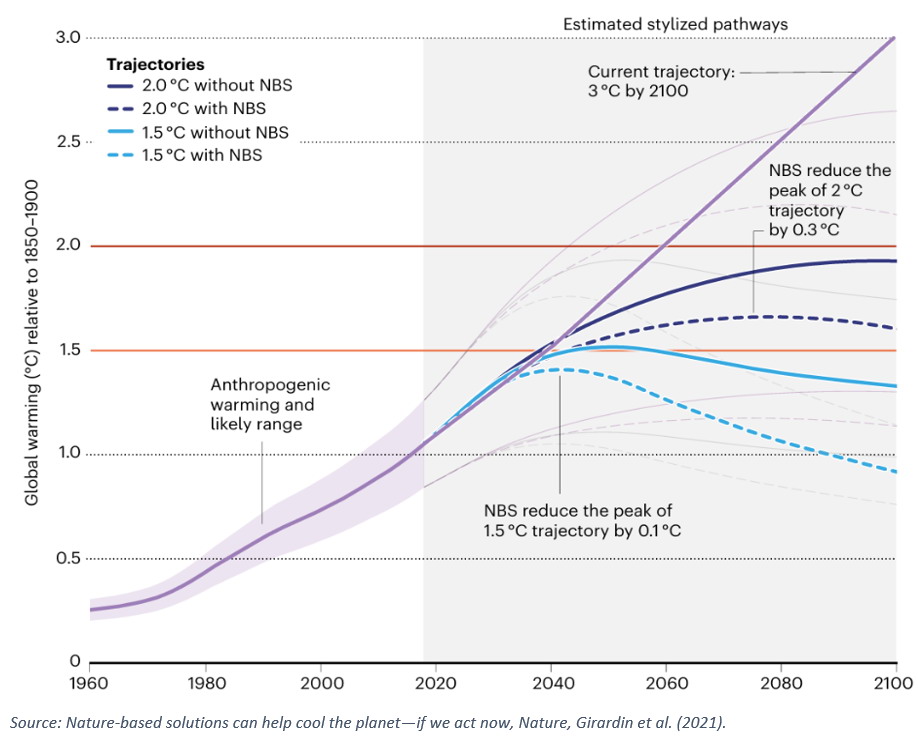
Increased temperature in Urban centres due to the Urban Heat Island phenomenon is hazardous for the residents of urban cities from the point of view of their health. Adapting nature-based solutions is better than any other solution to reduce the increased temperature. We can reduce the 27℉ temperatures of the surroundings, so there is a need for policies to adapt the nature-based solutions to mitigate the effect of UHI. The following graph shows the importance of Nature-Based Solutions.
References:
- Hayes, A. T. (2023). Nature-based solutions to mitigate urban heat island effects in Canadian cities: literature review/author (s): A. Hayes, Z. Jandaghian, MA Lacasse, A. Gaur, H. Lu, A. Laouadi.
- Sahani, J., Kumar, P., & Debele, S. E. (2023). Efficacy assessment of green-blue nature-based solutions against environmental heat mitigation. Environment International, 179, 108187.
- Girardin, C. A., Jenkins, S., Seddon, N., Allen, M., Lewis, S. L., Wheeler, C. E., … & Malhi, Y. (2021). Nature-based solutions can help cool the planet—if we act now. Nature, 593(7858), 191-194.
- U.S. Environmental Protection Agency, Using Green Roofs to Reduce Heat Islands, https://www.epa.gov/heatislands/using-green-roofs-reduce-heat-islands (accessed August 4, 2025).
Disclaimer: The views expressed in this piece are those of the author/s and do not necessarily reflect the views or policies of AIDMI.