

Search
Or hit enter to search
By Dr. Milind Mujumdar, Retired Senior Scientist, CCCR–IITM, Pune, Maharashtra, India
Until a few decades ago, rising per capita energy consumption was seen as a symbol of development, but it is now clear that fossil fuel–based energy and industrial processes drive greenhouse gas emissions, disturb Earth’s radiation balance, and accelerate global warming. With rapid urbanisation and the expansion of “concrete jungles,” the need for sustainable energy practices is more urgent than ever. Climate change is increasingly perceptible, especially through the steady rise in evening and night-time temperatures. A long-term IITM study (Krishnan et al., 2020) confirms this warming trend will persist for decades.
For urban residents, stored heat in roofs and walls prevents homes from cooling at night, reducing the effectiveness of fans or coolers and prompting households to rely on energy-intensive air conditioning (AC). However, every 1°C drop in indoor temperatures may raise outdoor temperatures by nearly 2°C, exacerbating the urban heat island effect. Overdependence on AC also weakens the body’s natural adaptability, which Ayurveda explains through seasonal balancing of Vata, Pitta, and Kapha. Moreover, glass-heavy buildings exacerbate indoor heat and humidity, while high-speed ceiling fans circulate discomfort rather than ventilating. Running fans slowly aids ventilation, while higher speeds should be reserved for tasks like drying floors. Ultimately, sustainable, science-based practices are essential for long-term comfort and resilience.
The question, then, is whether we continue down the path of ecological degradation or choose to live in harmony with nature. The solution lies in applying science, especially meteorology, to everyday life.
A practical solution for indoor cooling lies in using two strategically placed exhaust fans along with an understanding of how air circulates inside a room.
Meteorology in day-to-day life, understanding daytime and night-time airflow and effective use of cross-ventilation.
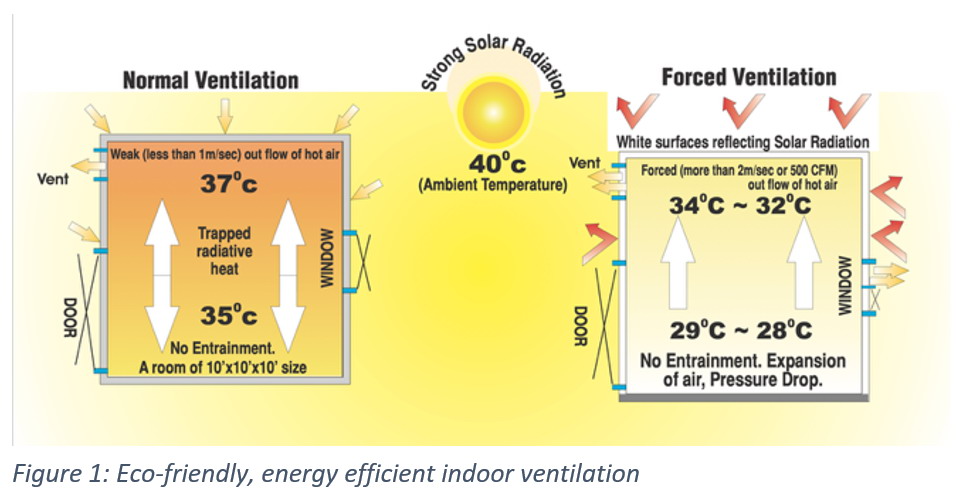
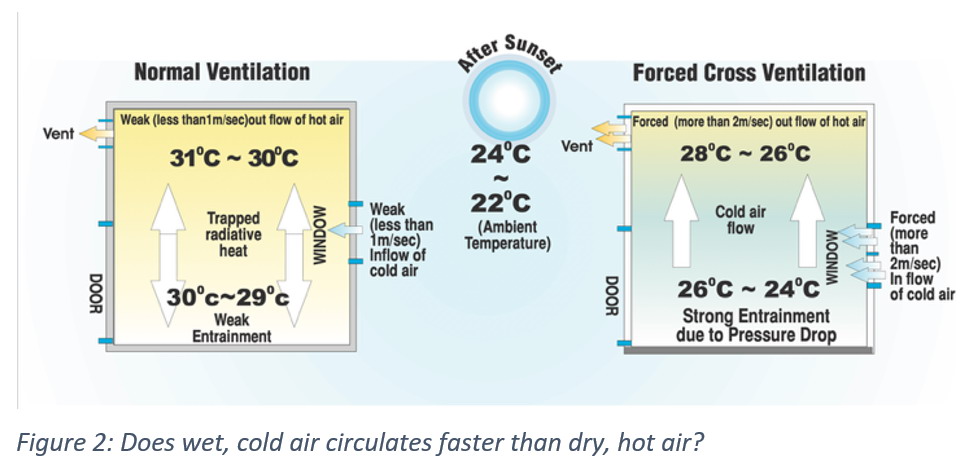
Forced cross ventilation: Warm air, being lighter, naturally rises and accumulates near the ceiling. While ceiling fans running at high speed push this hot air downwards in a cone-shaped flow, circulating the heat instead of removing it. To overcome this, one exhaust fan should be placed in a window where the outdoor inflow is stronger, so that cooler external air is drawn inside. Meanwhile, a second fan, ideally positioned opposite and closer to the ceiling, should be used to expel the hot indoor air. Sealing the outlet fan’s edges can further improve efficiency. Depending on the time of day, the system can be adjusted: for instance, during the cooler late evenings and nights, fresh air should be drawn in, while during the hot afternoons, the focus should be on expelling warm air. Under strong daytime solar radiation, normal ventilation yields weak air exchange (<1 m/s), which traps radiative heat and maintains indoor temperatures comparable to the ambient temperature. In contrast, forced (crossed) ventilation actively expels hot air (>2 m/s; Givoni, 1994), aided by reflective surfaces, thereby reducing indoor temperatures. After sunset, indoor spaces cool slowly under normal ventilation, remaining slightly warmer than ambient due to weak inflow and poor heat removal. Forced cross ventilation enhances entrainment through pressure-driven airflow, lowering indoor conditions to much closer to ambient. The effectiveness of this system can be enhanced by incorporating an electronic timer to automate hourly intake and exhaust cycles. Additionally, inlet air filters may be used if necessary.
Simple measures such as reflective rooftops, efficient appliances, smart AC use, and sensor-based lighting can reduce heat load and save energy. Passive cooling methods—such as misting, managing humidity, or even placing cold-water-soaked socks — offer low-cost relief. Innovative eco-friendly technologies worldwide show that comfort need not harm the planet. If households adopt such practices, the collective impact can ease climate stress. In a warming world, small, mindful actions help us live comfortably, sustainably, and in closer harmony with nature.
References:
Disclaimer: The views expressed in this piece are those of the author/s and do not necessarily reflect the views or policies of AIDMI.
