By Sujata Saunik and Mihir R. Bhatt, India
The road ahead for Maharashtra requires bridging innovation, investment, and inclusion without doubt. The following are five areas for its road map:
- Institutionalise Cooling in Development Planning of Maharashtra: Cooling must be mainstreamed within state and district disaster management plans, urban missions, and agricultural policies. The Maharashtra State Disaster Management Authority (MSDMA) can spearhead a coordinated “Heat and Cooling Resilience Mission” that brings together the departments of health, agriculture, and energy under a single convergence framework by 2030.
- Fund Resilience, Not Disasters: As AIDMI’s work with IIED demonstrates, locally managed recovery funds and micro-insurance are faster, more trusted, and more inclusive of gender. Embedding such financial mechanisms into climate budgets and CSR investments will ensure that resilience funding reaches the most exposed communities before crises unfold. Leadership corporate initiatives in Maharashtra can develop such a mechanism of Rs. 100 crores for the state.
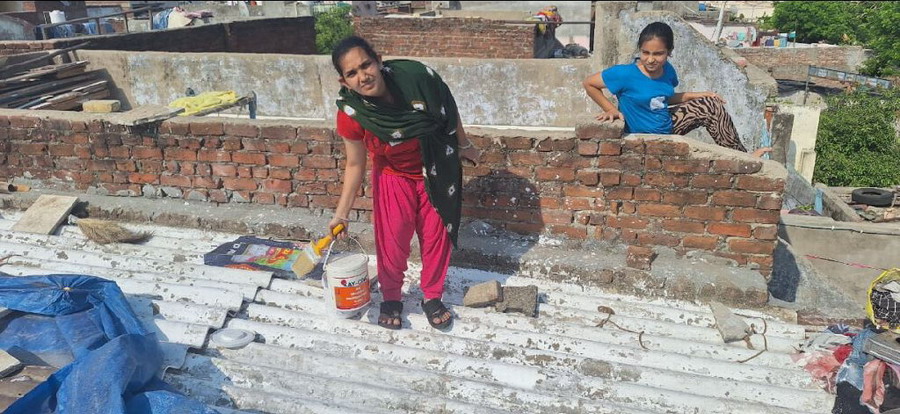
- Scale Community Cooling Solutions: Pilots in Nagpur, Beed, and Jalgaon have demonstrated measurable reductions in temperature through the use of low-cost cool roofs, shade structures, and passive ventilation. These should now move from demonstration to district-wide programmes supported by urban local bodies and the private sector to at least 50 cities and towns by 2030.
- Build a Cooling Economy: Extreme heat adaptation can generate green jobs—from the local manufacturing of reflective paints and bamboo-jute panels to retrofitting schools and Anganwadis with climate-smart cooling solutions. Linking such initiatives to state skill missions can make resilience economically rewarding. Develop a concept proper for the cooling economy with multi-stakeholder consultation and the Maharashtra Planning Board by March 2026.
- Strengthen Research and Policy Linkages: Continuous collaboration among AIDMI, IIED, IITM, TISS, and state agencies can refine evidence, monitor impacts, and develop replicable models for all districts of Maharashtra under a 5-year programme.
In essence, Maharashtra’s “cooling transition” is both an adaptation and a development opportunity. Grounded in community finance, guided by data, and driven by inclusive governance, the state can chart a new national pathway—where protecting citizens from extreme heat becomes central to sustainable growth and social justice.
| “The way ahead is to finance resilience, not disasters—by empowering small businesses, farmers, and cities of Maharashtra to design their own cooling futures, supported by science and solidarity.” |