

Search
Or hit enter to search
By Sujan Mandal[1], Suchismita Roy[1], and Dr. P.G. Dhar Chakrabarti[2]
The developed countries of the global North took the lead in making substantial public investments in structural and non-structural measures for reducing the risks of disasters, and in developing market mechanisms for risk transfer and insurance. In the absence of such initiatives by the national governments of the Global South, due to resource constraints and other compelling priorities, it fell upon civil societies in developing countries to mobilise support for creating awareness about disaster risks and taking grassroots-level, community-based initiatives for disaster risk reduction.
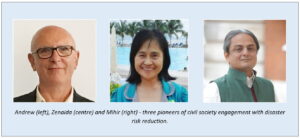
In this regard, the three front-running civil society organisations from the global south were the Centro de Estudios y Prevención de Desastres” (PREDES) Peru, the Citizen’s Disaster Response Center (CDRC) Philippines and the All India Disaster Mitigation Institute (AIDMI) India. PREDES was established in 1983 by three Peruvian individuals, with Andrew Muskrey at the helm; CDRC emerged in 1984 through the tireless efforts of Zenaida Delica-Willison; and AIDMI was founded by Mihir Bhatt, an architect and planner, in his hometown of Ahmedabad, Gujarat. While Andrew and Zenaida left the societies they founded to build their careers at the UN, Mihir has stayed with his organisation, steering it to grow as one of the most prominent civil society organisations in the region and the world.
The Organisation
Established during the Gujarat droughts of 1987-89, and registered formally in 1995 as an NGO, AIDMI has worked over the years in the intersecting areas of disaster risk reduction, climate change adaptation and humanitarian action with a focus on vulnerable sections of communities, developing their capacities and implementing innovative projects for building resilience of rural and urban communities to disasters and climate change. AIDMI links local communities with national and global initiatives for risk reduction, relief and long-term recovery programmes to build resilience. As an action-oriented and learning organisation, AIDMI promotes disaster risk mitigation by supporting, capturing, processing and disseminating information, lessons and ideas on disaster risk reduction. In this endeavour, AIDMI routinely conducts stakeholder roundtables, training of trainers, reviews, evaluations, research studies, and pilot projects, with citizens at the centre.
The Publication
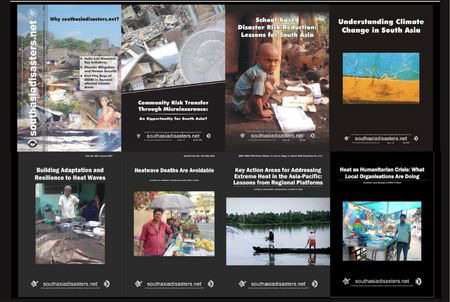
To support this endeavour, AIDMI launched its publication, Southasiadisasters.net, in June 2005, marking the tenth anniversary of its registration. The publication has completed its twenty continuous years of publication, and this issue stamps the 225th number of the publication – an incredible achievement of a civil society organisation that relies on the voluntary efforts of a group of professionals and activists dedicated to the cause of reducing risks of disaster and climate in different parts of South Asia in general and India in particular.
The Southasiadisasters.net is clearly a publication with a difference. It is not an academic or research publication. It is not peer-reviewed nor Scopus-indexed. Nor is it a newsletter of the organisation. It is primarily a publication of practitioners from around the world working on disaster and climate resilience in diverse sectors, including rural and urban development, science and technology, agriculture and animal husbandry, women and children, the elderly, and individuals with disabilities, among others. It covers various levels, ranging from local to national and global. Many of these practitioners are eminent scholars and researchers in their respective fields, but they write concise, relevant articles on the key lessons learnt from their research or fieldwork that can be useful for action. Hence, the articles are not pedantic in their approach but are oriented towards providing practical solutions to the problems. The average article size does not exceed 800 words, making them easy to read and comprehend for ordinary readers.
Themes
Each of the past 224 issues of Southasiadisasters.net is dedicated to a particular theme, with an average of 10 articles woven around the theme. Some themes have been repeated in successive issues to provide diverse perspectives, thus creating a database of 2,413 articles. A bibliometric analysis of the publication issues and articles presents a rich tapestry of knowledge of building disaster and climate resilience.
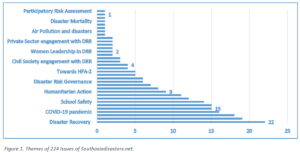
Maximum number of 22 issues were devoted to ‘Disaster Recovery’ after various catastrophic disasters in South and South East Asia, followed by ‘Natural Hazards’ (19 issues), ‘Disaster Risk Reduction’ (18), ‘COVID-19 Pandemic’ (16), ‘Climate Change and Disasters’ (15), ‘Catastrophic Disasters’ (15), ‘School Safety’(14), ‘Urban Risks and Resilience’ (12), ‘Disaster and Climate Resilience’ (11), ‘Humanitarian Action’ (9), ‘Community Based Disaster Risk Management’ (8), ‘Asian Regional Platform on DRR’ (7), ‘Disaster Risk Governance’ and ‘Risk Transfer and Micro-insurance’ (6 each), ‘Early Warning System’ and ‘Towards HFA-2’ (5 each), ‘Disaster Risk Management Plan’ and ‘Disaster Response’ (4 each), ‘Civil Society engagement with DRR’ (3), ‘Capacity Building’, ‘Women Leadership in DRR’, ‘Knowledge Network’, ‘Disaster Preparedness’, ‘Private Sector engagement with DRR’, ‘Disaster Relief & Rehabilitation’ (2 each) and ‘Harnessing Science & Technology’, ‘Air Pollution and disaster’, ‘Complex Disasters’, ‘International Cooperation’, ‘Disaster Mortality’, ‘Global Platform on DRR’, ‘Heritage Risk Management’, and ‘Participatory Risk Assessment’ (1 each). One issue of Southasiadisasters.net was devoted exclusively to the contributions of Dr Ian Davis and Ms Zenaida Delica-Wilson in the fields of disaster risk reduction, while the 50th Issue of Southasiadisasters.net was a special issue on Southasiadisasters.net itself.
Writing in this special issue, Ben Wisner observed: “The 49 issues of Southasiadisasters.net appearing between May 2005 and July 2008 are a mirror or microcosm of progress worldwide in getting disaster risk taken seriously as a challenge to development and translating that policy consensus into concrete action at the local scale. Risk is an integral part of daily life for most people who depend directly on natural resources for their livelihoods.”[3] The daily risks faced by common people, created by exposure to vulnerable conditions and the hazards of nature and a changing climate, along with their struggles to live with, adapt to, and recover from disasters, have filled nearly 6,000 pages of the 224 issues of Southasiadisasters.net over the past two decades.
Numbers
A total of 2413 articles have been published in these issues, averaging 10.7 articles per issue and 114.9 articles per year. The number of issues published each year has varied, ranging from a maximum of 21 in 2014 to a minimum of 4 in 2023, with an average of 10.6 issues per year.
Of the total number of 2413 articles published in Southasiadisasters.net, 803 articles are country-specific, while nearly double the number (1610) are general and issue-based. Expectedly, the overwhelming majority of 715 country-specific articles are from South Asia, with India topping the list with 573 articles, followed by Nepal (45), Bangladesh (42), Sri Lanka (25), Pakistan (18), Afghanistan (8), Maldives (3) and Bhutan (1).
Among the country-specific articles on non-South Asian countries Myanmar tops with 10 articles, followed by Indonesia (9), Japan (7), China (6), Mongolia, Philippines and Thailand (5 articles each), Cambodia (4), Canada and Vietnam (3 each), Brazil, Democratic Republic of the Congo, European Union, Russia, Malaysia, Poland and Turkey (2 each) and Albania, Australia, Colombia, Kenya, Korea, USA, Mali, Netherlands, Norway, Portugal, Saudi Arab, South Sudan, Sweden, Switzerland, Tanzania, Uganda, and Uzbekistan (1 article each).
1610 general articles largely follow the thematic pattern of the Southasiadisasters.net issues, as shown in Figure 1. Articles on disaster recovery tops (9.82%), followed by natural hazards (8.48%), disaster risk reduction (8.04%), Covid-19 (7.14%), climate change (6.70%), catastrophic disasters (6.70%), school safety (6.25%), urban risk and resilience (5.36%), disaster and climate resilience (4.91%), humanitarian action (4.02%), CBDRM (3,57%), regional platform (3.13%), governance (2.68%), micro-insurance (2.68%), early warning system (2.23%), HFA-2 (2.23%), DM Plan (1.79%), disaster response (1.79%), civil society (1.34%) etc.
Authors
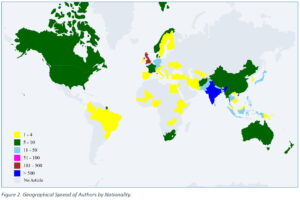
Names of authors of 1889 articles are published in the publication; the remaining 524 articles are anonymous. Nationals of as many as 67 countries contributed articles to the publication. Expectedly, majority of authors are Indians (1237 articles), followed by British (138), Bangladeshis (49), Swiss (47), Sri Lankans (35), Nepalese (34), Thai (32), Pakistanis (19), Japanese (17), German (16), Indonesians (11), Australians, Canadians and French (10 articles each). Nationals of the remaining 53 countries contributed between 91 articles each. UN Officials who contributed as many as 56 articles are not included in this analysis of the nationality of authors. A map showing the geographical spread of authors is given below.
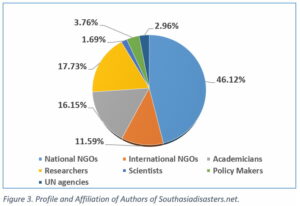
The overwhelming majority of authors (1090) are practitioners from civil society organisations, mostly working with rural or urban communities at the grassroots level. Of these, 871 belong to national NGOs, and 219 are affiliated with international NGOs. Heads and senior officials of almost every prominent national and international NGO engaged in disaster risk reduction, humanitarian action, and climate change adaptation in India, South Asia, and other regions of the world have contributed articles to Southasiadisasters.net. These include SEEDS India, Sphere India, CARE India, Save the Children, ActionAid, Caritas, Oxfam, RedR, ALNAP United Kingdom, NSET Nepal, CDRC Philippines, IFRC Geneva, ADRRN Japan, GNDR, Aga Khan Development Network, Pan American Health Organization,
ARUP, BRACED, Plan International, CDP Philippines, ADPC Bangkok, LEAD Pakistan, DPNet Nepal, Christian Aid, CASA, Transparency International, IUCN Gland, CDKN London, Cordaid Netherlands, Tearfund United Kingdom, COAR Afghanistan, ICVA Thailand, to name a few. Contributions from all these and several other organisations have made the 224 issues of Southasiadisasters.net probably one of the largest repositories of DRR practitioners’ insights into the dynamics of risks as perceived by the communities and the complexities and challenges of risk reduction on the ground. Some of these insights would be well-suited for compilation into a separate publication.
The practitioners are joined by academicians and researchers from universities, research institutions, and policy think tanks from around the world. Academicians from universities and colleges have contributed 305 (16.15%) articles, while researchers in universities and other organisations, including media, have contributed as many as 335 (17.73%) articles. They have presented their perspectives and insights in simple language understandable to common readers and practitioners. Academicians and scholars from almost every prominent university and research institution in India and South Asia, and some of the leading universities in the USA and Europe, have contributed to the publication.
Some of the academicians have come forward to curate a special issue of Southasiadisasters.net as guest editor, such as the special issue 175 on ‘Understanding Recovery in Andaman and Nicobar Island’, which was planned, designed and edited by Professor Janki Andheria, Head of Jamshetji Tata School of Disaster Studies, Tata Institute of Social Sciences, Mumbai, Scientists from various Science and Technology (S&T)- Based organisations, engineers, agricultural scientists, and medical professionals have also joined, contributing as many as 32 articles. These include scientists from the India Meteorological Department, the National Remote Sensing Centre, the Indian Institutes of Technology, the Indian Council of Agricultural Research, the Indian Council of Medical Research, etc.
Policy makers from national and provincial governments, both serving and retired, have contributed a total of 71 articles, adding value to the publication with their insights, comments, and advice. Many of these civil servants have played a crucial role in the prominent authors who have contributed to the publication make up the Who’s Who in Disaster Risk Management. These include Ian Davis, Ben Wisner, John Twigg, Zenaida Willison, Salvano Briceno, Sir Graham Watson, Margareta Wahlström, Tony Vaux, Emily Wilkinson, Marla Petal, P K Mishra, Kamal Kishore, Sashidhar Reddy, Nanda Kumar, Asitha de Silva, Dilanthi Amaratunga, Richard Haigh, Taufika Ophiyandri, Jennifer Doherty, John Mitchell, Natalie Lovell, Catherine Forbes, JC Gaillard, Daniel Kull, Dr. Ilan Kelman, Marc Gordon, Manu Gupta, Prema Gopalan, U.C. Mohanty, Jean–Philippe Thomas, Jyoti K Parikh, Madhavi Malagoda Ariyabandu, Santosh Kumar, Koji Suzuki, G. Padmanabhan, Sara Ahmed, Sanny R. Jegillos, Puji Pujiono, Dr Nibedita S. Ray-Bennett, P.G. Dhar Chakrabarti and many more, and above all, Mihir R Bhatt, the indomitable spirit behind the AIDMI and its publication the Southasiadiasters.net.
As the name suggests, the publication utilises the internet to connect the communities of practitioners with academicians, researchers, scientists, and policymakers in India, South Asia, and across the world, sharing knowledge, exchanging ideas, and sparking thoughts for innovative, inclusive, and sustainable solutions to build climate- and disaster-resilient communities. The 225th issue of the publication marks a milestone in a more promising journey that lies ahead.
[1] Phd scholars, School of Environment and Disaster Management, Ramakrishna Mission Vivekananda Educational and Research Institute, Narendrapur Campus, Kolkata, India.
[2] Professor Emeritus, Ramakrishna Mission Vivekananda Educational and Research Institute, Narendrapur Campus, Kolkata, India.
[3] Ben Wisner, ‘Conclusion: Glass Half Full, Glass Half Empty’, Southasiadisasters.net, Special Issue 25, July 2009.
Disclaimer: The views expressed in this piece are those of the author/s and do not necessarily reflect the views or policies of AIDMI.
