

Search
Or hit enter to search
By Kevisato Sanyu, Founder, NagaEd, Nagaland, India
Nagaland’s School Safety Policy (SSP) Compliance Course offers a clear lesson for disaster risk governance: when the state sets the mandate and a capable private partner delivers with discipline, policy moves from paper to practice. Conceived as a Public–Private Partnership (PPP) between the Nagaland State Disaster Management Authority (NSDMA), the Department of School Education (DoSE), and NagaEd, the course launched on 1 December 2023, Statehood Day, signalling ownership at the highest levels and immediate system legitimacy. By June 2024, nearly a fifth of all teachers in the state were registered, surpassing Phase 1 targets by almost 200% and proving that a digital compliance model can overcome geography, time, and budget constraints while strengthening trust in public systems.
The governance design was the engine of success. NSDMA set policy direction and convened inter-departmental coordination; DoSE drove adoption across the school system, integrating data flows and issuing official notifications; and NagaEd delivered the digital courseware, learning management system, and responsive support. The partnership, formalised on 9 June 2023, moved from agreement to execution with a milestone-based plan: course modules signed off by 24 November; 46 EBRC master trainers prepared on 28 November; a mandatory compliance circular; and a coordinated media rollout. Hosting and linking the course through official channels ensured open access and reinforced legitimacy.
Crucially, the PPP treated technology as an enabler of compliance and culture, not an end in itself. The system emphasised measurable adoption at the teacher level, shifting school safety from static guidelines to trackable action. From day one, the partners pursued national relevance, designing a quality course that states can adapt and license—placing replication and accountability at the centre.
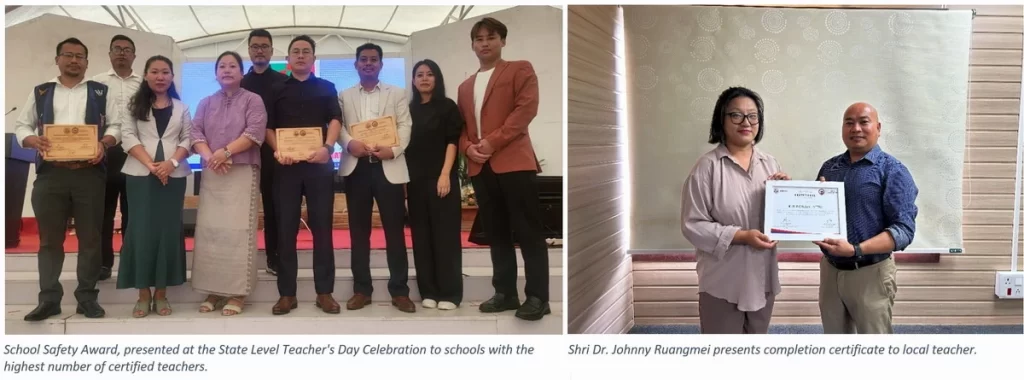
Inclusion was not an afterthought; it was foundational. National guidelines are unequivocal: school safety applies to every school and must be woven into daily routines. In Nagaland, where roughly 65% of children attend private schools, the PPP operationalised this principle by onboarding private institutions alongside government schools. DoSE and NSDMA enabled equitable tracking by sharing private-school teacher and UDISE data; EBRCs mobilised government schools while the All Nagaland Private School Association (ANPSA) reached private schools. By Phase 1 close, registrations included 24% of government teachers and 13% of private-school teachers, evidence of programmatic, not token, inclusion.
Implementation matched the ambition. Following launch, a certification workflow and monthly reporting provided a simple, transparent compliance pathway. User feedback underscores design quality and classroom fit: 73% said the self-paced format did not disrupt teaching; 90% found videos engaging; 95% considered learning checks important, and 68% found them easy to attempt. Relevance was near-unanimous: 98% agreed the SSP course is needed in Nagaland, and 96% affirmed that objectives were clear.
A sustained outreach strategy amplified uptake and confidence. During Phase 1, the campaign delivered 16.76 lakh ad impressions and reached 3.64 lakh users across digital and traditional media, correlating with the surge in registrations from May to June. Together, delivery discipline and transparent communication strengthened public confidence in both the education and disaster management systems.
Four takeaways stand out for national replication: a shared vision with target-driven milestones; inclusion by design to avoid coverage gaps; operational clarity that respects classroom realities; and a child-safety focus that builds practical readiness, mock drills, first aid/CPR, and evacuation planning, at the school level. In sum, the NSDMA–DoSE–NagaEd PPP is a replicable playbook: align mission, digitise for scale, include every school, and measure what matters. The case for nationwide scaling is compelling because making school safety everyone’s business is precisely how we keep every child safe.
Disclaimer: The views expressed in this piece are those of the author/s and do not necessarily reflect the views or policies of AIDMI.
