

Search
Or hit enter to search
By Dr. Mittul Vahanvati, Program Manager and Senior Lecturer, School of Global Urban and Social Studies, RMIT University, Melbourne, Australia
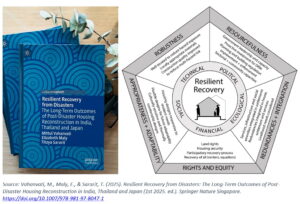
People everywhere are experiencing heat, as well as increasing intensity, frequency and complexity of floods, storms and earthquakes due to a changing climate. We are living in a ’new abnormal’, which demands innovative ways of planning, housing design, construction, maintenance, and governance. However, that requires us to learn from the past, about actions that have worked at reducing disaster risk, averting future disasters and building resilience.
Post-disaster housing reconstruction and recovery is a long-term process that determines whether communities become safer or remain vulnerable to future hazards or stresses. However, there is limited research on long-term outcomes of post-disaster housing reconstruction. Following are some of the long-term outcomes following the 2001 Gujarat earthquake and the 2008 Kosi floods in Bihar, housing reconstruction and recovery efforts, and their implications for informing more practical and inclusive actions on extreme heat.
Improvised building standards and skills trainings for resilient housing and households. Housing is not only a structure; it is linked to health, work, culture, infrastructure, human rights and climate-resilience. Housing should be framed as a system (material, energy flows) within a system (cultural, legal/building standards). Buildings can provide the first layer of buffer and safety from floods, earthquakes and heat. Designing resilient buildings is one of the best ways of adapting to a changing climate. However, are we still building as per the building standards that are outdated for the changing climate, only to face costly retrofitting, stress and anxiety later?
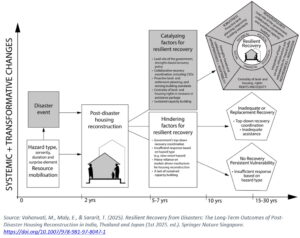
In context of heat, it is worth inquiring whether our building standards are relevant for the changing climate. Is there a need for improvising building standards for thermal comfort and inclusion of traditional materials?
Building standards should be accompanied with guidance notes showing best-practice examples of house orientation, wind flows at settlement scale, passive design principles and nature-based solutions for cooling.
Without adequate enforcement of building standards and skills training of construction labour, mere building standards won’t change the building culture.
Proactive land and settlement planning based on risk mapping and integration of nature-based solutions. E.g. in case of Kutch, Gujarat, land readjustment was done in the central Bhuj’s old town to make it safer, allow for fire trucks to access roads and allow people to evacuate. However, people from the central Bhuj area were relocated to another earthquake-prone zone, due to lack of land. Relocation and rebuilding ought to reduce future disaster risk, not rebuild vulnerability.
In context of heat, proactive heat risk mapping must be done. Such a map should also include identification of socio-economically vulnerable groups.
Our cities are much hotter than regional or rural areas due to urban heat island effect, and due to lack of integration of green-blue infrastructure. Green-blue infrastructure can not only help with cooling hotter areas, but it would also support disaster risk reduction and provide additional societal benefits such as biodiversity, cleaner air, and human well-being.
Policies and programs, when tailored to context-specific needs and strengths, have the greatest potential to bring about large-scale changes. E.g. both Gujarat State Disaster Management Authority (GSDMA) and Bihar SDMA adopted an owner-driven housing reconstruction policy and recovery program. That allowed households to make decisions about their housing recovery based on their values, aspirations and needs. Government provides households with social support and technical support apart from financial support to rebuild or adapt existing buildings to better standards for safety and sustainability.
For extreme heat action planning, government has to play a proactive role. They can tailor programs such as subsidised retrofitting of existing housing for cooling. They could offer technical support to each household to provide tailored advice about the sort of retrofitting required for heat resistance/ cooling.
However, policies and programs would not have the foreseen effect without adequate enforcement and monitoring to keep corruption at bay.
Additionally, the other challenge is to do with funding. Who would pay for such retrofitting and how will government be able to subsidise such a program?
To ensure equity and inclusiveness of the program, government must consider providing more financial assistance to lower-income groups.
Lastly, a long-term view of post-disaster housing recovery is a valuable source of learning for extreme heat action planning. For example, due to a dedicated agency for emergency management and recovery, for each state, i.e. SDMA, government has experienced, and developed institutional capacity for continual learning and proactive planning. Such continuation of a dedicated authority moves from a seasonal mindset to continual disaster management mindset.
In case of heat action planning, government authorities must move beyond seasonal response towards long-term risk reduction.
Sustained capacity building of the construction sector equally important as sustained capacities of the government organisation’s officials.
Reference:
Disclaimer: The views expressed in this piece are those of the author/s and do not necessarily reflect the views or policies of AIDMI.
