

Search
Or hit enter to search
By Abhiyant Tiwari and Anshima Mishra, NRDC India
India’s heat governance is at an inflection point. For nearly two decades, Heat Action Plans (HAPs) have been the country’s primary instrument for managing extreme heat, growing from a single city-level plan in Ahmedabad in 2013 into a sprawling policy architecture spanning 23 heat-prone states. As of June 2026, India’s heat governance encompasses over 250 HAPs across various cities. The question today is no longer whether a city has a plan, but whether that plan protects the people most exposed to heat.
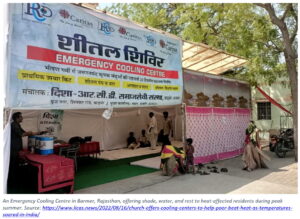
India’s heat governance has matured considerably in recent years. Following Odisha’s pioneering 1999 plan, adopted after a heatwave that claimed over 2,000 lives the previous year, and Ahmedabad’s globally studied 2013 plan, the National Disaster Management Authority has worked with the India Meteorological Department across 23 states to push HAPs toward becoming standing institutional mechanisms, anchored to colour-coded early-warning triggers rather than ad hoc emergency response. A newer generation of HAPs is also grounding response around heat vulnerability risk assessments and locally derived temperature thresholds for early warning, rather than a single national criterion applied uniformly across climatologically different cities. This is being matched by movement on the financing side: heatwave mitigation projects, such as cooling shelters and early warning systems, can be eligible for funding under the National and State Disaster Mitigation Funds (NDMF/SDMF), while the 16th Finance Commission has additionally recommended, that heatwave be added to India’s nationally notified disasters list, which would open up the complete state and national disaster response funds (SDRF/NDRF) for relief and compensation as well.
Yet progress in the number of plans has outpaced progress in their design. There is a meaningful difference between a heat-intentional measure and a heat-incidental one, and most HAPs lean heavily on the latter. Tree plantation drives, water kiosks, and shaded infrastructure often exist for other civic reasons and simply get folded into the heat narrative, rather than being designed from the ground up around who actually bears the heat burden. That burden falls unevenly. Street vendors, construction labourers, domestic workers, and small business owners remain peripheral to most plans, named in vulnerability lists but rarely designed for. So do the elderly, the chronically ill, residents of poorly ventilated informal settlements, and migrant workers who fall outside a city’s data systems entirely. Most HAPs also operate at the city level, missing intra-city heat variation that can span several degrees between wards, so resources get allocated blind to where exposure actually concentrates. Few plans explicitly factor in the compounding heat exposure and unpaid care burden faced by women informal workers, even though they are among the most consistently exposed.
The next phase of India’s heat governance needs to be as forward-looking as the crisis itself, anticipating exposure rather than just responding to it. That starts with seeing risk more clearly: occupation and gender disaggregated heat-health data, paired with ward-level heat mapping powered by satellite and AI-based urban heat island analysis, would let cities direct resources to where risk is actually concentrated, not just where temperatures are highest on average. It also means reaching people faster. Heat alerts folded into the digital welfare and wage-payment systems millions of informal workers already use would travel further than posters and loudspeaker announcements ever could, and parametric heat insurance, paying out automatically once a temperature threshold is crossed, could offer workers and small businesses a financial cushion without the delays of conventional claims. And finally, it means building heat resilience into the city itself: treating nature-based cooling, tree cover, reflective and green roofs, revived water bodies, as core infrastructure rather than a beautification add-on.
Heat and cooling are often treated as separate policy tracks, one a disaster-response issue, the other an energy and infrastructure one, even though they affect the same people for the same underlying reason: those most exposed to extreme heat are usually those with the least access to cooling. The Centre of Excellence for Heat Resilience and Sustainable Cooling, launched in April 2026 through NRDC’s partnership with the Government of Maharashtra, brings the two together under one institutional mandate. Anchored eventually within Maharashtra’s State Institute of Disaster Management, it offers a model for cross sectoral long-term HAP intervention at scale: research, capacity-building, and technical support that persist well beyond any single heatwave season.
Extreme heat, as this issue argues, encompasses both rapidly intensifying and prolonged events, with health, environmental, and socioeconomic impacts that are unevenly distributed across populations. The next generation of Heat Action Plans must treat informality, gender, and granularity not as addenda, but as design parameters from the outset, anchoring response not just to temperature, but to who is left exposed when temperatures rise.
Sources:
Disclaimer: The views expressed in this piece are those of the author/s and do not necessarily reflect the views or policies of AIDMI.
