

Search
Or hit enter to search
By Jyoti Mackwan, General Secretary, SEWA, India
| “Some members took high-interest loans from local moneylenders due to the heat crisis. When they couldn’t repay, they were harassed and asked for favours no woman should endure. This is climate and gender injustice.”
— SEWA Grassroots Leader |
Introduction
For the 3.8 million informal women workers represented by Self Employed Women’s Association (SEWA), extreme heat is not measured in degrees Celsius or global averages — it is measured in meals missed, pregnancies lost, sleep stolen, and bodies pushed past every safe limit. Extreme heat is not simply a weather event. It is a slow-onset, compounding, and deeply unequal disaster — one that cascades through bodies, households, economies, and generations. It falls hardest on those our systems were not designed to protect.
Why “Slow-Onset” Matters — and Who Bears the Burden
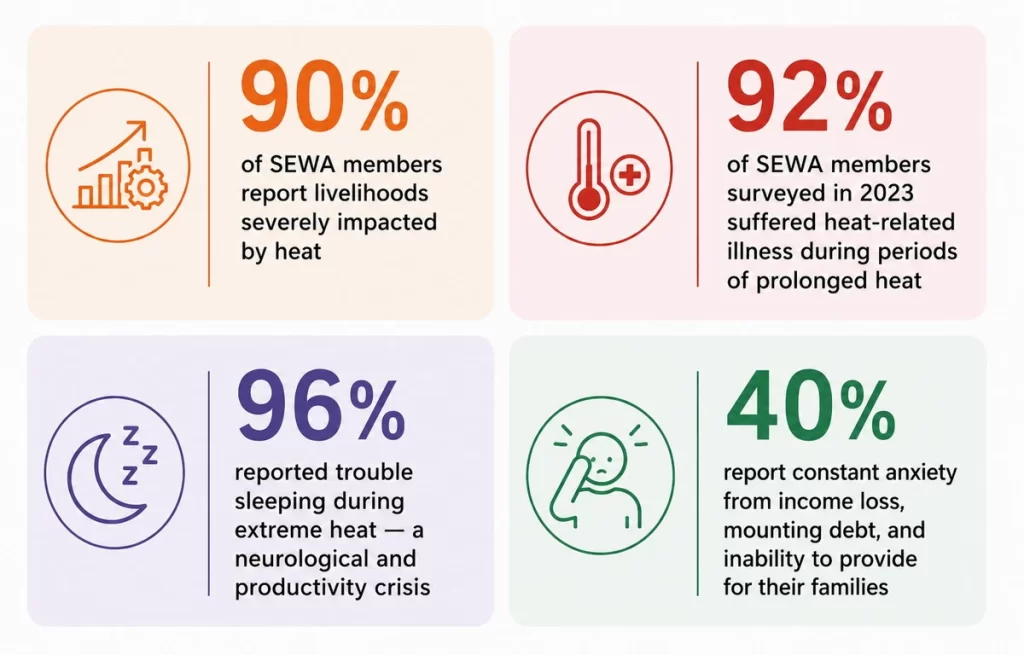
Unlike floods or storms, extreme heat rarely produces immediate and visible losses. Its impacts accumulate over time through reduced labour productivity, adverse health outcomes, maternal health risks, and increased household expenditures. As a result, many of its consequences remain poorly captured by conventional disaster assessment frameworks. This creates a problem of measurement rather than impact. Losses of income during prolonged heatwaves are seldom recorded as losses related to disasters. Institutional frameworks are better placed to measure discrete events and direct damages than the cumulative and dispersed effects of heat. The consequences of this undercounting extend to policy and finance. Indicators used to guide adaptation planning and resource allocation tend to prioritise losses that are easily observable and quantifiable. This is reflected in climate finance patterns: despite growing evidence linking climate change and public health, health-focused interventions continue to receive a very small share of multilateral climate finance.
These impacts are also unevenly distributed. Exposure to extreme heat is mediated by existing socioeconomic inequalities, including poverty, informal employment, and gender. Workers in the formal sector may have access to workplace protections, flexible schedules, or cooled environments. Informal workers generally lack such safeguards and are more likely to experience income losses, productivity declines, heightened health risks, and increased financial vulnerability.
Women in the informal economy suffer from the double burden of paid work and unpaid domestic labour, both of which are exacerbated during heatwaves. Women are often housed in thermally inefficient housing — usually tin-roofed, densely packed and poorly ventilated — where heat builds up during the day and continues to linger at night, weakening the body’s ability to recover between bouts of exposure.
Informal sector workers often work long hours under the relentless sun, and are at significant risk of heat stress, heat exhaustion, and heat stroke. Many SEWA members either do not have access to clean drinking water or sanitation facilities. The decreased water intake which makes them susceptible to dehydration and urinary tract infections. Many outdoor workers suffer from several dermatological issues including burns, ulcers, fungal infections, and rashes in their palms and soles.
40% of SEWA members report constant anxiety from income loss and mounting debt. When income collapses and moneylender debt accumulates at extremely high interest rates, family dynamics fracture along predictable lines of gender and power. SEWA grassroots leaders document an associated rise in domestic violence, substance abuse, and in some communities, suicides. These are not peripheral impacts — they are the downstream consequences of a thermal climate shock meeting a system with no buffers.
Disclaimer: The views expressed in this piece are those of the author(s) and do not necessarily reflect the views or policies of AIDMI.
