

Search
Or hit enter to search
By Kumudu Herath, Duryog Nivaran Project Manager for SIDRRA[1]
Extreme heat is increasingly affecting health, livelihoods, productivity and everyday life across South Asia. Like any disaster, its impacts are not experienced equally. Women working in small-scale sectors, persons with disabilities, and socially excluded communities often have fewer resources and options to prepare, respond and recover.
The SIDRRA project was grounded in the understanding that disaster impacts are not experienced equally across communities. While the project addressed multiple hazards, its experience in strengthening inclusive, community-based and locally led disaster risk governance offers useful lessons for advancing gender-responsive heat action.
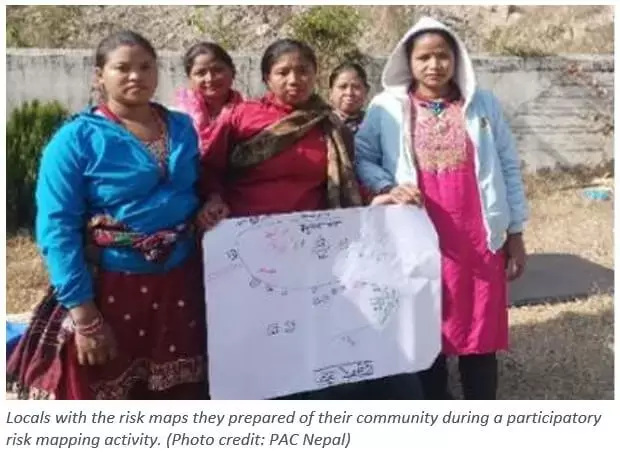
In Sindhupalchowk, Nepal, Practical Action worked with communities and local governments to strengthen impact-based forecasting, risk communication and anticipatory action. Participatory risk mapping helped communities to identify not only hazard-prone areas, vulnerable households and safe locations, but also different vulnerabilities shaped by gender, social structures and livelihoods. The project also highlighted the importance of simple and accessible warning messages to ensure that people with different levels of literacy can understand and act on risk information.
The SIDRRA experience also highlights the value of women as active agents for preparedness and resilience. In Mirpurkhas, Pakistan, a member of a Peasant Women’s Trade Union in a flood-prone village who lives with a disability caused by polio, gained practical knowledge on early warning and safe evacuation through project training. Having experienced the devastating floods in 2022, she understood the importance of early action and conducted cascade training for other villagers, particularly women and persons with disabilities. This experience demonstrates the importance of investing in women’s leadership and ensuring that those most exposed to risk can also contribute to designing and communicating solutions.
Community-led environmental management is another important pathway for building resilience to climate-related disasters. In Kailali, Nepal, community forest user groups combined forest fire preparedness with recharge ponds generating benefits for fire control, water conservation, recreation, fisheries, and ecotourism. Women increasingly participated in leadership and decision-making in forest fire management, while male champions were also engaged to address restrictive gender norms. These nature-based and locally managed solutions demonstrate how climate resilience can simultaneously address environmental, social and livelihood concerns.
In addition, the project supported some exploratory studies and contributed towards extreme heat and risk communication. All India Disaster Mitigation Institute (AIDMI) provided evidence from five Indian cities on how extreme heat and climate events translate into loss and damage for small businesses. The findings highlighted that those most exposed to climate risks are often least equipped to respond, emphasising the need for people-centred climate finance with targeted support for informal women workers, poor households, and home-based producers. They also highlighted the need for integrating small business protection into city-level Heat Action Plans. The regional study conducted by Practical Action Consulting India further highlighted that effective risk communication is not only a technological issue but also a governance challenge, requiring trusted and accessible information, clear decisions, and two-way communication.
The wider value of these experiences lies in regional learning and cooperation. Local innovations become more influential when they are documented, shared and connected to policy and practice across countries. SIDRRA created such connections by bringing community experiences into regional dialogues, knowledge products and advocacy processes. This demonstrates how regional cooperation can help transform locally grounded practices into shared learning and collective action for a more inclusive and climate-resilient South Asia.
In conclusion, learning from SIDRRA experiences, effective and gender-responsive heat action requires attention to women as active agents, community-led and nature-based solutions, simple and accessible early warning, and stronger regional learning and cooperation.
[1] This article is based on the experience and learning of Duryog Nivaran through the recently concluded regional programme, Strengthening Inclusive Disaster Risk Governance for Climate Resilience in Asia (SIDRRA), implemented in partnership with IRC and ADRRN.
Disclaimer: The views expressed in this piece are those of the author(s) and do not necessarily reflect the views or policies of AIDMI.
