

Search
Or hit enter to search
By Joyce Nyaboga, Senior Network Development Adviser (Design and Infrastructure), UK; and Mihir R. Bhatt, AIDMI, India
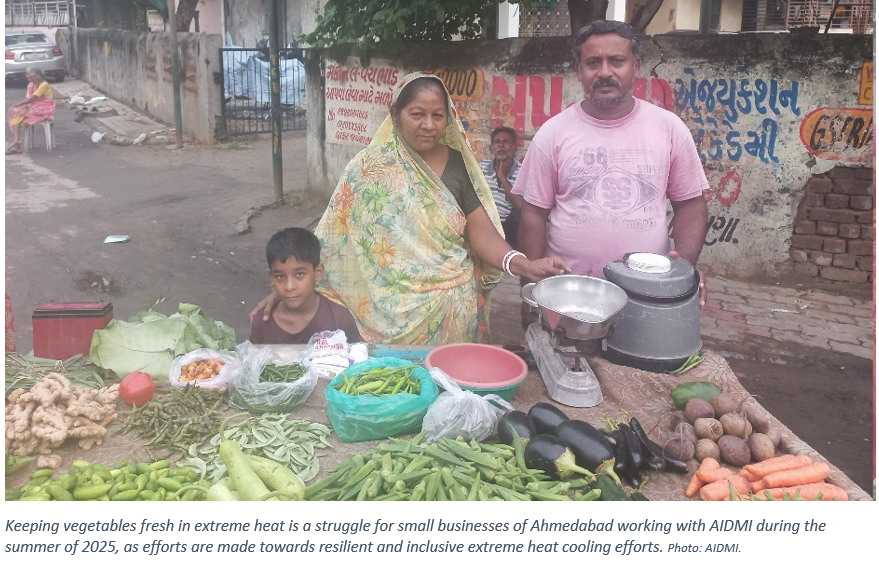
To many communities, heatwaves have long been accepted as a normal part of life—unavoidable and routine. But as this issue of Southasiadisasters.net illustrates, extreme heat is fast transforming into a full-blown humanitarian crisis. From small businesses in Ahmedabad to schools in South Sudan, and from women workers in Bihar to traditional builders in Karaikudi, the evidence gathered here reinforces a clear and urgent message: locally led action is not just helpful—it is essential.
As we move forward, the following six priority areas offer a roadmap for scaling effective, equitable, and enduring heat resilience:
Adaptation begins with what communities already know. Traditional architecture, water conservation practices, clothing designs, and local coping routines offer time-tested solutions. These must be integrated with modern anticipatory tools to build context-specific, culturally rooted resilience. Innovation should emerge not from replacing local knowledge, but from strengthening and evolving it.
Governments must recognise heatwaves as disasters in their own right. Policy frameworks—national, regional, and global—should embed heat preparedness into climate adaptation, urban planning, labour protection, education, and public health. From classifying heatwaves under disaster laws to financing community-based heat action plans, a coherent and inclusive policy response is urgently needed.
Preparedness must reach every level—from households to municipalities. Investing in training, tools, and local leadership—especially among women, youth, and workers—will amplify resilience. Platforms for south-south learning and horizontal exchange between local organisations across borders can accelerate peer-driven solutions to common climate challenges.
Heatwaves are not isolated events. They intersect with water scarcity, food security, energy access, and migration. Solutions must therefore be cross-sectoral—linking health services with infrastructure, urban planning with agriculture, and gender equity with climate adaptation. Heat resilience should not be a siloed response but part of a broader just and climate-resilient development agenda.
Smart cooling is possible and affordable. Investments in passive cooling design, reflective materials, rooftop insulation, urban greening, and renewable energy-powered cooling centres are proven and scalable. Integrating these into housing schemes, transport systems, and workplaces can significantly reduce risk, particularly for the urban and rural poor.
Robust data on the localised impacts of heat—on productivity, health, education, and livelihoods—is urgently needed to inform funding, policymaking, and implementation. Evidence of cost-effective, community-driven solutions can unlock new investment and catalyse mainstream adoption of what works on the ground.
In closing, as temperatures rise, the path ahead must be guided by community wisdom, backed by responsive policy, and powered by shared learning and collaboration. Local organisations have shown what is possible. Now it is time to support, scale, and sustain their efforts.
