

Search
Or hit enter to search
By Rituraj Neog, Assistant Professor, Department of Geography, Gargaon College, Simaluguri, Assam, India; and Shukla Acharjee, Assistant Professor, Department of Geography & Centre for Atmospheric Studies, Dibrugarh University, Dibrugarh, Assam, India
Heat stress is a major environmental challenge in urban areas worldwide driven mainly by climate change, rapid urbanisation and land-use/land-cover (LULC) transformations. Northeast India, a major tropical region of the country, is witnessing increasing urbanisation-induced LULC changes leading to the degradation of urban green and blue infrastructure (BGI). Cities located in the Brahmaputra Valley such as Guwahati, Silchar, Nagaon, Jorhat, Dibrugarh, Tinsukia and Tezpur are experiencing rapid urban expansion and substantial rural-to-urban migration, putting considerable pressure on the existing ecological resources and urban landscapes.
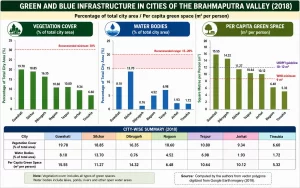
According to available estimates for 2018, vegetation cover accounts for only 19.78% of the total area in Guwahati, followed by Silchar (18.85%), Dibrugarh (16.35%), Nagaon (10.60%), Tezpur (10.80%), Jorhat (9.34%) and Tinsukia (6.60%).
These values are considerably lower than the recommendation of the International Union for Conservation of Nature (IUCN) Urban Alliance, which advocates at least 30% vegetation cover in urban areas to maintain favourable microclimatic conditions and ecological sustainability. Similarly, blue infrastructure, particularly urban water bodies, plays a crucial role in regulating urban thermal environments through evaporative cooling and heat dissipation. The proportion of water bodies also remains relatively low across most cities, accounting for only 8.10% of the area in Guwahati, 13.70% in Silchar, 6.98% in Tezpur, 4.52% in Nagaon, 1.93% in Jorhat, 1.72% in Tinsukia, and merely 0.76% in Dibrugarh. These values fall substantially short of the commonly recommended threshold of 15–20% water coverage required for effective thermo-regulation and the development of heat-resilient urban environments.
Per capita availability of urban green space provides another important indicator of ecological adequacy. The World Health Organisation (WHO) recommends a minimum of 9 m² of green space per person, while the Urban and Regional Development Plans Formulation and Implementation (URDPFI) Guidelines prescribe 10–12 m² per capita for Indian cities. Although Guwahati, Dibrugarh, Silchar, Tezpur, and Jorhat currently exceed these thresholds, Nagaon and Tinsukia exhibit comparatively lower per capita availability of green space, reflecting increasing ecological stress. Furthermore, the rapid growth of urban populations, particularly in Guwahati, Tezpur, Dibrugarh and Silchar, is likely to intensify pressure on existing green and blue infrastructure, leading to a progressive decline in per capita ecological resources.
Consequently, continued urban expansion and associated LULC transformations are expected to compromise the ecological functions of urban landscapes, thereby reducing their capacity to mitigate heat stress and regulate local climatic conditions. In this context, the restoration of degraded green and blue infrastructure, the protection of existing ecological assets, and the strategic utilisation of vacant and open spaces to develop new BGI networks are essential for enhancing urban thermal resilience and promoting sustainable urban development in the rapidly urbanising cities of the Brahmaputra Valley.
Disclaimer: The views expressed in this piece are those of the author/s and do not necessarily reflect the views or policies of AIDMI.
