

Search
Or hit enter to search
By AIDMI Team, India[1]
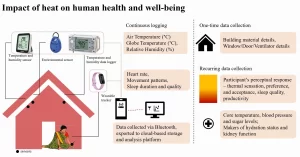
Extreme heat is no longer only an environmental concern. It is shaping how people live, work, sleep, care for family members, and recover in Indian cities. However, heat action planning still tends to focus mainly on outdoor temperatures. This misses an important part of the problem: for many people, the most sustained heat exposure takes place indoors, especially in affordable housing, informal settlements, and small workspaces. For low-income families, women workers, children, older persons, and people with health conditions, the home is not only a shelter. It is also a workplace, a care space, and a place where the body must recover.
A key lesson from recent research is that temperature alone does not explain heat risk. Humidity is equally important. According to NASA Jet Propulsion Laboratory, for every 1°C of global warming, atmospheric humidity may rise by about 7 percent. When humidity is high, the body’s natural cooling through sweating becomes less effective. Heat stress can therefore become dangerous even when temperatures appear moderate. This is particularly true in Indian cities during the pre-monsoon and monsoon months, when heat and humidity tend to combine.
Buildings can either protect people from heat or worsen their exposure to it. Poorly designed homes may absorb heat during the day and release it slowly at night. This affects sleep, recovery, health, learning, care work, and productivity. For women and home-based workers, indoor heat is also a livelihood issue, as it can reduce working hours, output, and income.
Urban heat resilience therefore requires a shift from simply “cooling buildings” to improving comfort and safety for people. Whole-room air-conditioning is often unaffordable, unreliable, and energy-intensive. More practical options are ventilation, shaded openings, reflective roofs, insulation, low energy cooling and personal comfort systems.
Better housing design and neighborhood planning are central to this shift. New housing should consider orientation, roof insulation, shaded windows, reflective surfaces, and materials that reduce indoor heat gain. Existing homes need practical retrofits such as cool roofs, roof shading, external window shading, and ventilation improvements. Beyond the house, shaded streets, trees, green corridors, permeable surfaces, rain gardens, and blue-green infrastructure can reduce heat while supporting water management.
The way forward is to connect housing, health, livelihoods, urban planning, and disaster risk reduction. Heat action planning must move closer to people’s lived realities, especially in low-income settlements where exposure is high and adaptive choices are limited.
[1] AIDMI acknowledges Prof. Rajan Rawal, CEPT University, for his insights on cooling, housing design, thermal comfort, personal comfort systems, and blue-green infrastructure, shared during the virtual round table on May 27, 2026.
