

Search
Or hit enter to search
By Dr. Ranjan Kelkar, Former Director General, India Meteorological Department, Pune, India
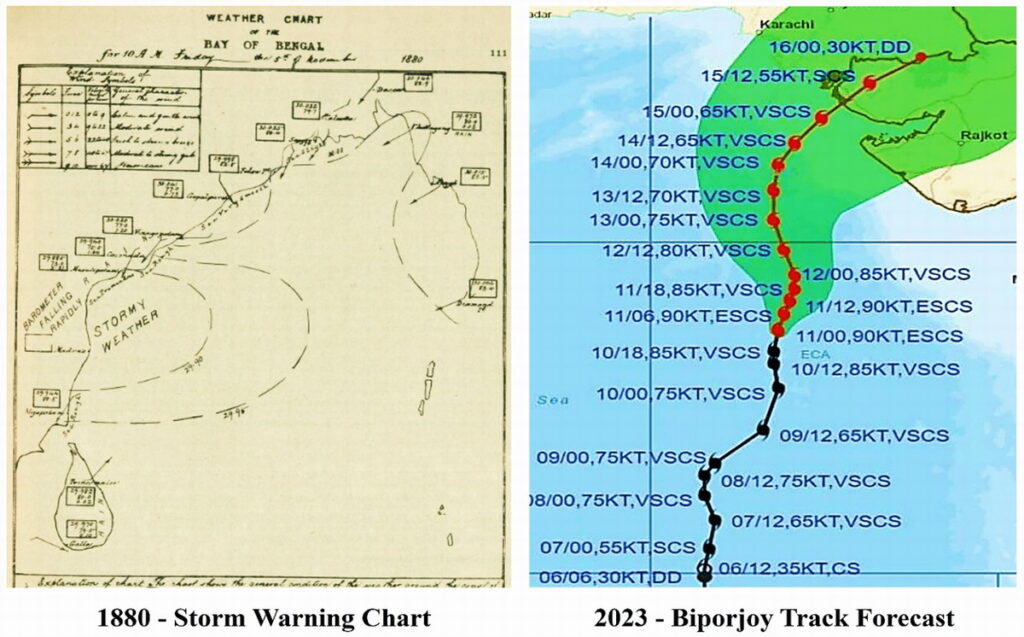
When the India Meteorological Department (IMD) was established in 1875, its two priority areas were shipping and agriculture. In the early years, ships were warned of impending storms only through visual signals hoisted at ports. Much later, around 1912, IMD began sending warnings to ships at sea by wireless messages. Captains of ships docking at ports would also brief IMD meteorologists about the weather they had encountered at sea. IMD could thus compile atlases of storm tracks over the Bay of Bengal and Arabian Sea. Over the years, IMD’s cyclone warning system has undergone a sea change.
When India was under British rule, it suffered from chronic droughts and famines in which thousands would perish. In 1932, IMD established a Division of Agricultural Meteorology at Pune dedicated to improving agricultural productivity in the country. IMD worked in close collaboration with agricultural institutions and set up a network of cooperating agromet observatories in the country besides its own. Crop-weather calendars were compiled that farmers could consult for timing their field operations. Crop-weather relationships were arrived at for predicting crop yields. IMD started issuing farmers’ weather bulletins over All India Radio in the 1950s and an Agromet Advisory Service for farmers was started in the 1970s which is now functional in all agroclimatic zones.
After the Second World War, military aviation saw a decline, but civil aviation got a sudden boost and required major operational support from IMD. All phases of aircraft operations are influenced by weather and current weather information and forecasts are crucial for flight safety and viability of airlines. As a member of the International Civil Aviation Organization (ICAO) and the World Meteorological Organization (WMO), India has to follow international regulations. Presently, IMD is providing aviation meteorological services at over 100 airports through four Meteorological Watch Offices (MWOs) and several supporting units at these airports. IMD has installed state of art observing systems at all major airports and it operates an Online Briefing System (OLBS) for pilots.
Methods and techniques of observation have changed immensely since 1975 and today, India has its own weather satellites and a countrywide radar network. IMD has developed mobile apps through which people, especially farmers, can quickly get timely weather information. In parallel with the advancement of technology, new branches of science like radar meteorology, satellite meteorology, and numerical weather prediction have evolved over the last few decades. IMD runs its own numerical models on supercomputers, and disseminates its products over the internet, social media and mobile apps. IMD issues nowcasts, medium and extended range predictions and long range forecasts. Their spatial domains range from the country as a whole to block and panchayat levels. Tracks of tropical cyclones are now being predicted several days in advance.
With the accelerated growth of the nation towards a trillion-dollar economy, the demand for meteorological services has been coming from many new quarters. IMD is now providing meteorological information and forecasts for irrigation, flood management, exploitation of solar and wind energy, offshore oil exploration, disaster mitigation, human health, air pollution, tourism and yatras. Many of these activities are multi-disciplinary and IMD has to coordinate with several other agencies to be effective. Heatwaves, landslides, urban flooding, forest fires, and lightning strikes are some of the areas in which there are high expectations from IMD. The future is challenging, but IMD is well prepared for it.
Disclaimer: The views expressed in this piece are those of the author/s and do not necessarily reflect the views or policies of AIDMI.
