

Search
Or hit enter to search
By Prachi Gupta, Seema Mundoli and Harini Nagendra, Azim Premji University, India
Are heatwaves just a matter of seasonal discomfort, or is there more to it? In India, the answer is disturbingly clear. As global temperatures rise, heatwaves have become more frequent, intense, and deadly, disrupting lives, health, and ecosystems. In May 2016, Phalodi, Rajasthan, recorded a scorching 51°C, and in 2024 alone, India reported over 48,000 cases of heatstroke (CEEW, 2025). Vulnerable populations such as blue-collar workers, low-income populations, pregnant women, children, and the elderly are disproportionately affected. Women working in extreme heat outdoors face twice the risk of miscarriage or stillbirth (BBC News, 2024). By 2030, the country is projected to lose an equivalent of 34 million full-time jobs—not due to recession or machines—but simply because of rising temperatures (ILO, 2019).
The impact of heatwaves is more severe in cities. The urban heat island (UHI) effect can make urban areas up to 5°C to 10°C hotter than surrounding regions, as dense concrete and asphalt absorb heat by day and release it at night. Projections suggest that a 30% increase in urban vegetation could have prevented over 1.1 million heat-related deaths between 2000 and 2019, emphasising the lifesaving benefits of greening cities (Wu et al., 2025).
What if we designed our cities to live, to breathe, to cool by working with nature, not against it?
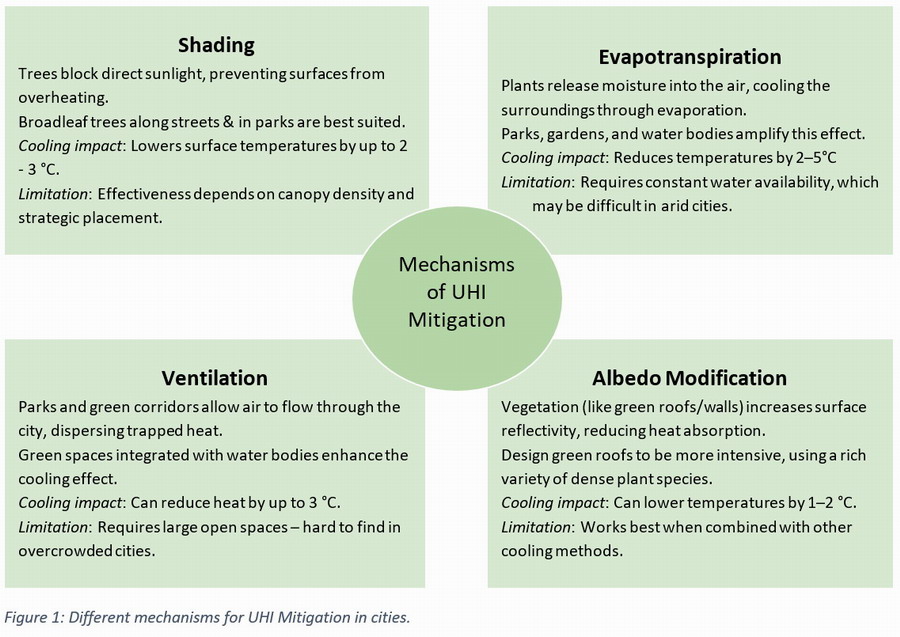
Nature-based solutions such as green (vegetation) and blue (water bodies) infrastructures can significantly mitigate the impact of heat stress. Urban green spaces such as parks, wooded groves, street trees and green roofs reduce UHI in metropolitan cities through multiple mechanisms (Figure 1). By shading paved roads and buildings, trees prevent them from absorbing and radiating heat. Simultaneously, through evapotranspiration, trees release moisture into the air, lowering the surrounding temperature (The Nature Conservancy, 2017). Moreover, greenery improves ventilation by allowing air to circulate more freely and enhances albedo, i.e., the reflectivity of surfaces. A study in Bangalore city showed that avenue trees can reduce road surface temperatures by 27.5°C and air temperatures by up to 5.6°C (Vailshery et al., 2013). In Bhubaneswar, remote sensing analysis showed that blue-green spaces were, on average, 2.1°C cooler than nearby built-up areas (Pritipadmaja et al., 2023).
The cooling effects of trees can result in energy savings of approximately 12% in residential areas (Liang and Huang, 2023). Key tree traits that influence trees’ cooling potential include canopy size, leaf density, transpiration rate, and leaf area index (Liang and Huang, 2023). Green spaces with layered vegetation—comprising trees, shrubs, and herbs, along with diverse tree species—are more effective in cooling (Wang et al., 2021). Even ground cover vegetation can reduce the amount of heat absorbed and stored by paved surfaces. In cities with limited space, green walls can act as insulating barriers on buildings (Imam and Banerjee, 2016). Beyond cooling, green spaces also enhance urban liveability by providing other ecosystem services, such as air purification, carbon sequestration, flood risk mitigation, climate regulation, and improved mental well‑being.
As India urbanises rapidly, with 600 million people projected to live in cities by 2036 (World Bank Group, 2024), we face a choice: do we continue building heat traps, or do we reimagine cities that breathe with nature? Greening our cities is not just a solution—it is a necessity for survival in a warming world.
Adapted from: Lin, H., & Li, X. (2025). The Role of Urban Green Spaces in Mitigating the Urban Heat Island Effect: A Systematic Review from the Perspective of Types and Mechanisms. Sustainability, 17(13), 6132.
References:
Disclaimer: The views expressed in this piece are those of the author/s and do not necessarily reflect the views or policies of AIDMI.
