

Search
Or hit enter to search
By Manu Bhatnagar, Principal Director, Natural Heritage Division, INTACH, New Delhi, India
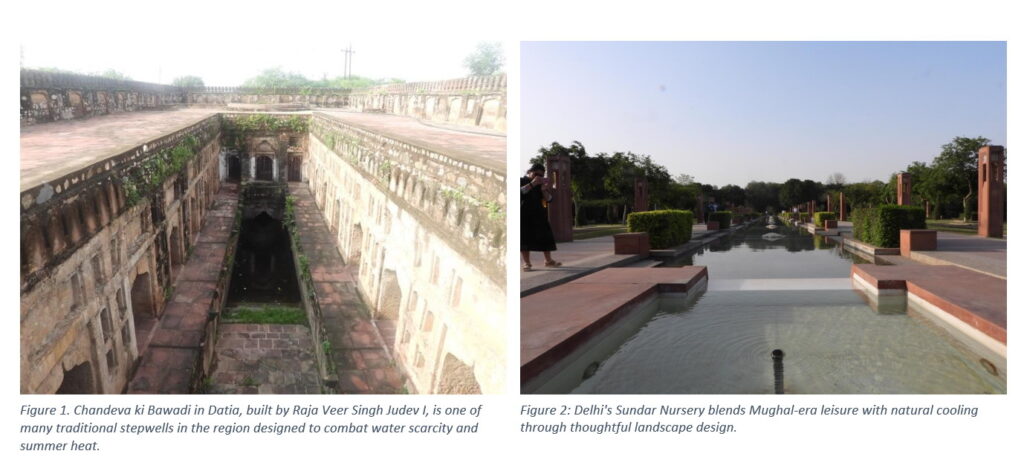
As Indian cities grapple with intensifying heatwaves due to climate change and rapid urbanisation, the urgency for sustainable, scalable, and context-specific cooling solutions has never been greater. While modern technology offers some respite, nature-based solutions (NBS) — particularly those rooted in India’s architectural heritage — present a time-tested, climate-responsive approach to urban cooling. These traditional practices, honed over centuries, seamlessly integrate local materials, passive design strategies, and ecological principles, making them both environmentally and culturally sustainable.
Historically, Indian architecture was designed in harmony with the climate. Structures in Rajasthan, for instance, employed thick sandstone walls, jaalis (perforated screens), and courtyards to reduce heat gain and enhance ventilation. Stepwells, or baolis, served not just as water reservoirs but also as subterranean retreats where communities gathered to escape the scorching sun. Elsewhere, rooms had high roofs permitting hot air to rise and escape through vents. In Kerala, sloped roofs, verandahs, and wooden lattices allowed for natural airflow and shade, maintaining thermal comfort even in humid conditions. Colonial bungalows were shielded with deep verandahs, with white painted walls to reflect the heat.
These vernacular practices embody core NBS principles — using natural systems and local knowledge to enhance resilience. Urban planners and architects today can draw from this repository to combat rising urban heat. For example, incorporating elements like shaded courtyards, green roofs, and breathable facades in modern buildings echoes the traditional emphasis on passive cooling. Similarly, restoring and integrating urban wetlands, stepwells, and tree-lined avenues into cityscapes can moderate temperatures while enhancing biodiversity and community well-being.
Several Indian cities are already turning to heritage for answers. Ahmedabad’s Heat Action Plan, the first of its kind in South Asia, includes cool roofing programs that promote white- painted roofs — a contemporary nod to the reflective surfaces seen in traditional desert homes. In Hyderabad, efforts are underway to restore baolis, recognising their dual role in water management and microclimate regulation. In Delhi, the revival of Mughal-era gardens such as Sunder Nursery shows how green heritage can act as an urban lung and a cooling refuge.
Heritage cities were pedestrian-oriented with shaded, narrow streets where the sun could not penetrate.
However, mainstreaming heritage-based NbS requires more than nostalgia. It demands interdisciplinary collaboration, policy support, and community engagement. Local governments must invest in mapping and preserving traditional assets, integrating them into heat action 4plans and urban development guidelines. Equally important is empowering artisans, architects, and cultural custodians who hold indigenous knowledge — turning them into active agents of climate resilience.
In an era where air conditioning dominates the urban cooling discourse — often at the cost of increased emissions and energy inequity — India’s heritage offers an alternative: one that is low-cost, inclusive, and ecologically aligned. Reviving traditional wisdom is not about reverting to the past, but reimagining its principles in alignment with new technologies for the future.
By treating heritage as a living resource rather than a relic, India can harness its cultural ingenuity to craft cities that are cooler, greener, and more resilient — proving that sometimes, the best innovations are the ones our ancestors already mastered.
Disclaimer: The views expressed in this piece are those of the author/s and do not necessarily reflect the views or policies of AIDMI.
