

Search
Or hit enter to search
By Sanjay Agrawal, Dy Director General, Disaster Management, Ministry of Communications, Government of India, New Delhi, India
As climate change intensifies the frequency and severity of natural disasters, effective early warning systems are crucial to minimising loss of life and damage. India, with its vast and diverse population, has developed one of the world’s most advanced and cost-effective Common Alerting Protocol (CAP)-based Integrated Alert System, setting a global example. Since its inception, India has delivered over 45 billion location-based SMS alerts, covering various disasters.
Key Features of India’s Early Warning System
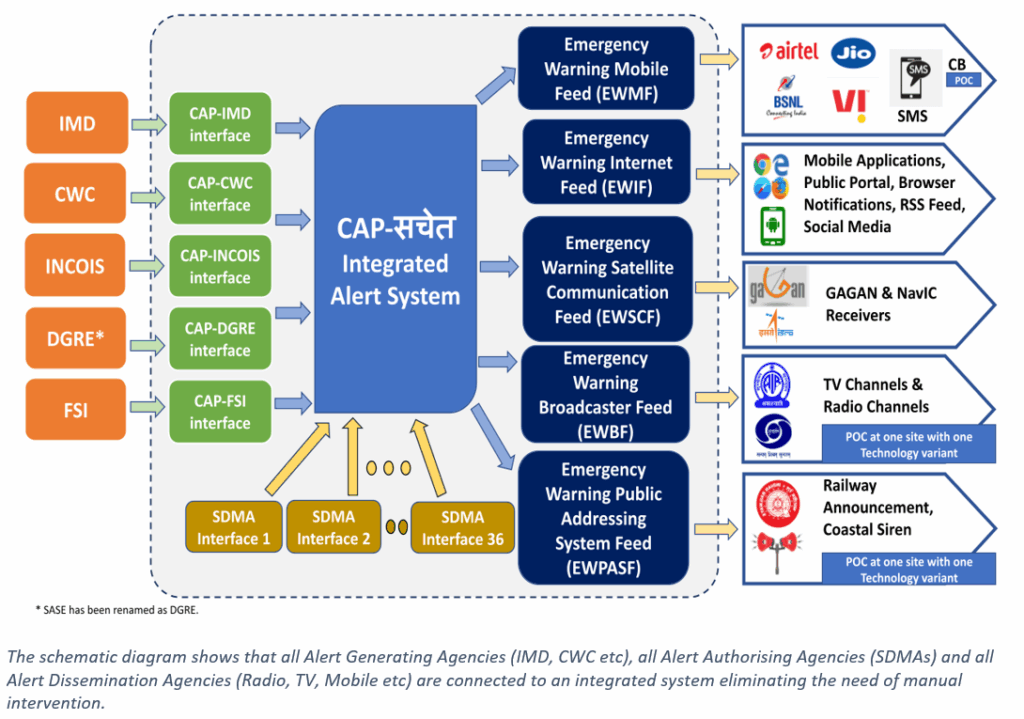
Integrated and Fully Automated: All stakeholders, including government agencies and local authorities, are connected through the system, and states have dedicated dashboards for monitoring. The system is fully automated, eliminating the need for manual intervention, ensuring timely and efficient dissemination of alerts.
| “We learned about the Sachet app during the training on extreme heat. I have installed it, and now I can plan my small business better to protect it from climate risks,” said a small business owner from Ahmedabad, Gujarat, India. Photo: AIDMI. |
Global Standards: Indian Early Warning system globally the largest to disseminate alerts to more than 1.40 billion population and it is designed on global standards of Common Alerting Protocol (CAP) i.e. ITU-T X.1303.
Geo-Targeted Alerts: Precision in disaster communication is essential. India’s geo-targeting capability ensures that alerts reach only those in affected regions, preventing unnecessary panic.
Multi-Mode Communication: India employs a multi-channel approach—SMS, mobile apps, radio, TV, satellite communication, and public address systems—to ensure no one is left out. The Sachet mobile app provides real-time alerts, while satellite-based systems like GAGAN and NavIC reach remote areas.
Timely Dissemination of Alerts: A successful early warning system depends on timely alerts. The system provides valuable lead time for individuals to evacuate or take preventive actions.
Multi-lingual support: Alerts are delivered in over 19 Indian languages, ensuring accessibility for diverse linguistic groups. This localised approach enhances disaster preparedness, facilitating better
| The schematic diagram shows that all Alert Generating Agencies (IMD, CWC etc), all Alert Authorising Agencies (SDMAs) and all Alert Dissemination Agencies (Radio, TV, Mobile etc) are connected to an integrated system eliminating the need of manual intervention. |
resource allocation and evacuation planning.
Overcoming Implementation Challenges: Regulatory and Policy Interventions
Implementing an effective early warning system in a vast and diverse country like India presents numerous challenges requiring regulatory and policy intervention by the Government challenges. Key interventions include:
Cost-Free Disaster Alerts: To remove financial barriers, the Government mandated zero tariffs for SMS and Cell Broadcast alerts, ensuring widespread use without budget constraints.
Enhancing Public Trust: A fixed SMS header was introduced for disaster alerts, increasing authenticity and reducing resistance from telecom providers.
Mandatory Cell Broadcast System: Initially absent in most networks, Cell Broadcast faced resistance from Telecom Service Providers (TSPs) due to security concerns. Following extensive consultations, the Government issued policy directives mandating its implementation across all networks.
Standardising Handset Compatibility: Mobile devices in India lacked uniform support for Cell Broadcast alerts. Policy directives, issued via Gazette Notification, ensured standardisation, enabling consistent alert reception.
Indigenous Technology Development: To reduce costs and dependency on foreign OEMs, C-DOT developed an indigenous Cell Broadcast system, now covering 60% of India’s telecom network. This scalable solution enhances resilience and national autonomy.
India’s Leadership in Global Early Warning Systems
By integrating indigenous technology, strategic policies, and global collaboration, India has set a global standard in disaster preparedness. Disseminating over 45 billion alerts, the system exemplifies scalability and efficiency, reinforcing India’s role as a leader in early warning systems. The United Nations (UN) and the World Meteorological Organization (WMO) aim for “Early Warning for All” by 2027, a goal India is well-equipped to help achieve. India can support other nations through capacity-building, regulatory guidance, and international collaborations. By sharing technology and expertise, India can facilitate the development of early warning systems tailored to other countries’ needs.
Disclaimer: The views expressed in this piece are those of the author/s and do not necessarily reflect the views or policies of AIDMI.
