

Search
Or hit enter to search
By Aniket Sawargaonkar, M.Sc. in Disaster Management, Jamsetji Tata School of Disaster Studies, Tata Institute of Social Sciences (TISS), Mumbai, India
These high temperatures characterise Maharashtra, as it is one of the Indian states that has been exposed to excessive heat, most recently in cities such as Nagpur, Chandrapur, Jalgaon, and Pune (Government of Maharashtra, 2025). Even though air conditioners and desert coolers provide temporary relief, they are not affordable for the majority of the population due to energy costs and infrastructure limitations. It has brought back interest in indigenous, climate-sensitive and community-based architectural responses, one of the brightest of which is the ancient Wada.
Wadas were large houses and administrative buildings built during the Maratha and Peshwa periods (17th-19th centuries). They were built with locally available materials—stone, brick, and mud —and designed to withstand the hot, semi-arid climate prevalent in the area. Wadas had ventilated corridors, central courtyards, and thick thermal-mass walls, which provided natural air conditioning and thermal comfort when electricity and cooling were far away (Vakharia & Joshi, 2024).
The centre courtyard of the Wada is the core that serves as the natural cooling and heating unit. It helps with vertical airflow: hot air rises and exits through the open courtyard, while cool air flows into the shady rooms. The masonry walls are also thick and maintain moderate temperatures by keeping out the violent afternoon sunlight and gradually dissipating stored heat in the evening. These conventional materials are effective in conferring insulation, unlike modern concrete structures that entrap and heat up (COEP Tech & SPA Bhopal, 2024).
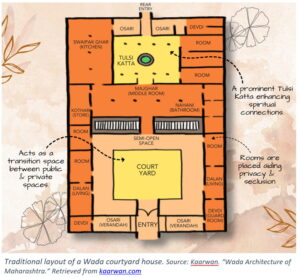
The transitional zones are composed of verandahs and shaded corridors to avoid direct sunlight and keep the interior cooler. Semi-open spaces allow residents to perform their household activities during the hottest hours of the day. Cross ventilation through strategically located small windows and latticed screens (jaalis) helps reduce heat gain while maintaining privacy with minimal material use. Mud or plaster floors are cool, and some Wada even have small fountains which help to cool by evaporation. Roofs are usually made of clay tiles, and timber beams are used, along with ventilation gaps, to allow heat to escape. Sun exposure is also reduced by the east-west orientation of buildings (Vakharia & Joshi, 2024).
These conventionally recognised design benefits have been supported by scientific review. In this study, Vakharia and Joshi (2024) found that the indoor temperatures of Wadas were maintained 4⁰C to 6⁰C below the outside temperatures, serving as thermal sinks. The temperature of the Wada walls was also found to be significantly lower than that of the adjacent concrete buildings. In their 2022 study, the authors of the present research reported that Wadas used 40 per cent less energy to cool their home than modern row houses and apartments.
Wadas are also creatures of climate resilience in addition to architecture. Areas such as verandahs enhanced not only thermal comfort but also social interaction between people. Several Wadas are still populated by local people, who also maintain them. Sensitively retrofitted, these buildings would be an essential component of modern climate adaptation planning, while also preserving cultural heritage. Instead of considering Wadas as relics of a bygone era, they should be viewed as culturally rooted, ecologically sustainable problems that are adaptable to present and foreseeable climate scenarios.
References:
| Wada architecture shows how tradition meets innovation—keeping homes 4–6°C cooler and communities resilient. Reviving these designs can inspire Maharashtra’s path toward sustainable, climate-smart living. These timeless structures prove that heritage can be a powerful solution to modern heat challenges. |
Disclaimer: The views expressed in this piece are those of the author/s and do not necessarily reflect the views or policies of AIDMI.
