

Search
Or hit enter to search
By Vishal Pathak, All India Disaster Mitigation Institute (AIDMI), India
As South Asian cities confront intensifying heatwaves, All India Disaster Mitigation Institute (AIDMI) is promoting and strengthening practices of Nature-Based Solutions (NbS) to address urban heat risks while enhancing equity and resilience. These solutions are vital for protecting vulnerable populations from the growing threat of extreme temperatures, particularly in informal settlements and high-density neighbourhoods.
Urban areas across India, Bangladesh, Pakistan, and Nepal are experiencing record-breaking temperatures, worsened by the urban heat island (UHI) effect. This phenomenon, triggered by dense built environments and limited vegetation, is especially dangerous for low-income and marginalised communities that lack access to cooling, water, or resilient infrastructure. In many Indian cities, extreme heat is now a leading seasonal hazard, exacerbating pre-existing vulnerabilities in housing, health, and livelihoods.
Nature-Based Solutions—including tree planting, green corridors, green roofs, restored urban water bodies, and permeable surfaces—not only cool the surrounding microclimate by up to 10°C but also contribute to stormwater management, air quality improvement, and mental well-being. These solutions can be integrated into existing government missions and urban development programmes to scale their impact.
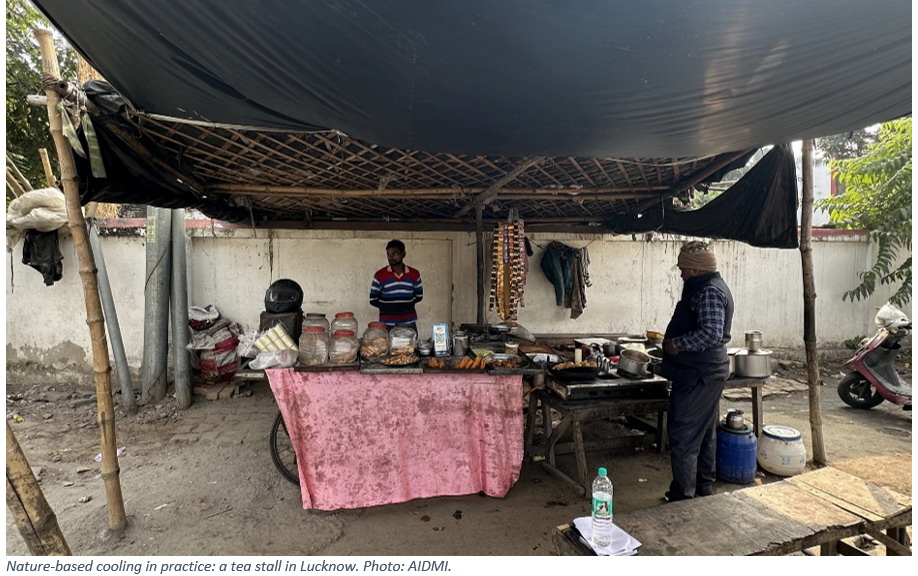
Several government initiatives already offer promising pathways. The National Bamboo Mission encourages the planting of bamboo in urban parks and degraded land, which can function as rapid-growth green barriers to heat. The Atal Mission for Rejuvenation and Urban Transformation (AMRUT) supports urban green space creation and waterbody rejuvenation in 500 cities, aligning directly with cooling goals. Similarly, the National Urban Livelihoods Mission (NULM) can be leveraged to engage the urban poor, especially women and youth, in the creation and maintenance of green assets such as urban nurseries, shaded vending zones, and rooftop gardens. Additionally, the Smart Cities Mission offers digital tools for heat mapping and performance monitoring of green interventions. AIDMI’s field experience across 18 states and multiple cities reinforces that such NbS are most effective when embedded in local plans of government bodies. In many cities, however, green infrastructure remains underfunded, fragmented across departments, and disconnected from climate vulnerability assessments.
AIDMI, through its work across 18 states in India, has long emphasised local strategies to reduce disaster risk. In a recent study[1] co-authored with the International Institute for Environment and Development (IIED), AIDMI documented how cotton farmers in Gujarat and Maharashtra are already experiencing more frequent heatwaves, reduced rainfall, and crop losses. While the study focused on rural vulnerability, the findings are directly relevant to urban settings, where rising heat similarly threatens health and livelihoods. To move forward, AIDMI is promoting a set of interlinked actions.
First, cities must embed green cover targets and heat-resilient zoning norms into urban planning codes and enforce them through building permits and development control regulations.
Second, municipal corporations and Smart Cities should be equipped with technical and financial capacity to design and maintain NbS, especially in slums and low-income areas.
Third, the role of citizen participation must be scaled up—community groups, resident welfare associations, and school eco-clubs can play a central role in sustaining green assets.
Fourth, urban heat mapping and climate vulnerability assessments must guide the implementation of NbS, ensuring resources reach the most at-risk communities.
Fifth, developing cross-sectoral NbS Task Forces within cities to coordinate across Health, Water, Housing, and Urban Development departments can create the much-needed synergies. The agenda must be long-term and sustainability-driven—where heat resilience, livelihood generation, and urban biodiversity are simultaneously achieved through NbS.
Additionally, greater alignment with national schemes such as PMAY–Urban, HRIDAY, and Swachh Bharat Mission–Urban can amplify NbS benefits by embedding green design in affordable housing, heritage conservation, and urban sanitation. Local governments can also partner with state-level Forest and Environment Departments to unlock Green India Mission funds for NbS pilots in high-heat zones.
Nature-based cooling is not merely an environmental remedy; it is a social necessity and a climate justice tool. As cities grow, they must do so thoughtfully—ensuring that shade, water, and greenery are not luxuries for the few but rights for all. The time to act is now. With collective ambition and the right convergence of government missions, India can lead the way in building greener, cooler, and more inclusive cities.
[1] Guarin, A., Blackmore, E., Pathak, V., Nicolini, G., Morell-Ducos, J. and Kelly, L. (2024). Building resilience for cotton farmers in India: Evidence from Gujarat and Maharashtra. IIED and AIDMI. https://www.iied.org/22481iied.
