

Search
Or hit enter to search
By Era Upadhyay, Amity Institute of Biotechnology, Amity University, Rajasthan, India
Abstract
Urban Heat Islands heighten heat stress, energy demand, and health risks in Indian cities. Cow dung-based paint, a high-albedo, VOC-free coating, offers thermal insulation, antimicrobial benefits, and durability. Field trials show 3–5°C roof cooling and 10–15% energy savings, supporting SDGs-11, 13 and India’s National Cooling Action Plan.
Introduction
India’s expanding cities face worsening Urban Heat Islands (UHIs), where concrete and asphalt raise local temperatures by 2–6°C (Akbari et al., 2009). Ahmedabad, Bengaluru, and Jaipur report notable nocturnal heat spikes, heightening stress, cooling demand, and health risks. Conventional paints exacerbate heat absorption and emit VOCs, degrading air quality (Goyal et al., 2021).
Recent advances in green chemistry point to an innovative alternative—cow dung-based paint. Formulated from renewable bio-waste, this coating offers high reflectivity, thermal insulation, and antimicrobial benefits, while being VOC-free and non-toxic. It aligns with circular economy principles and can be produced locally, supporting rural entrepreneurship (Kumar & Upadhyay, 2025).
Scientific Basis and Cooling Potential
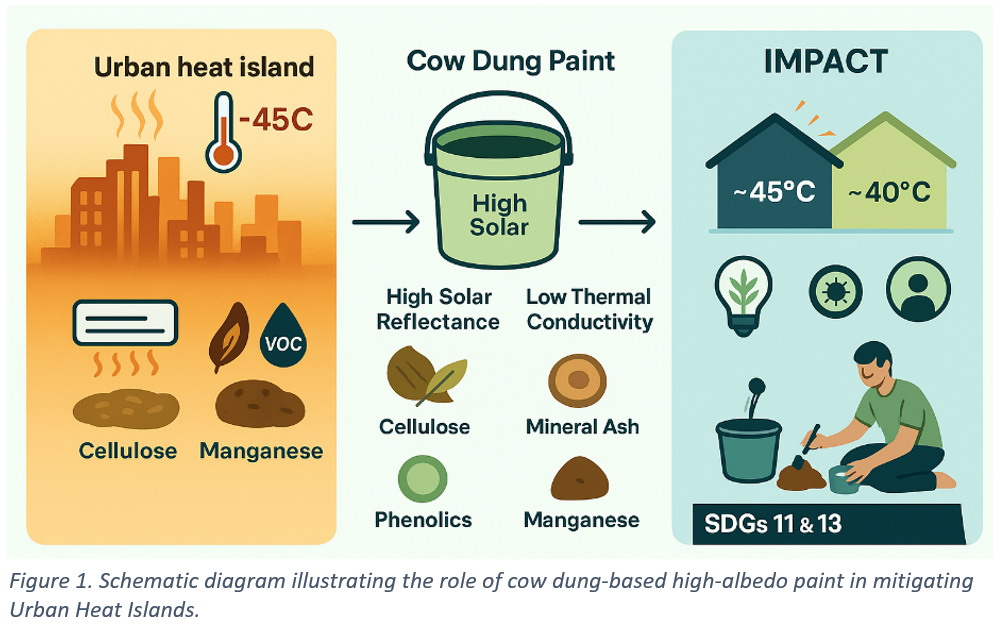
Cow dung naturally contains cellulose, lignin, and mineral-rich ash, enhancing solar reflectance and lowering thermal conductivity (Singh & Sharma, 2020). Analyses by Kumar and Upadhyay (2025) show a high pH (12.2) that inhibits microbial growth, low thermal conductivity, moderate phenolic content (1.52) for antimicrobial activity, and absence of toxic heavy metals, with only trace cadmium (1 ppm), chromium (5.26 ppm), and nickel (3.8 ppm). Manganese (11.6 ppm) improves durability, while UV-Vis spectra indicate natural pigments. Microbial tests confirmed bacterial and fungal resistance. With eco-friendly binders and pigments, cow dung paint remains VOC-free, non-toxic, and suitable for indoor use.. 4.4.25
Field trials recorded summer roof temperature reductions of 3–5°C compared to conventional paints, cutting cooling energy demand by 10–15%. Natural binders and manganese strengthen resistance to monsoon rains, UV, and dust. The low Water Pollution Index (0.20) indicates minimal aquatic toxicity, though the Heavy Metal Pollution Index (900) warrants careful sourcing and waste control.
Synergy with Nature-Based Cooling Strategies
High-albedo cow dung paint can be paired with green roofs, urban greening, and reflective pavements to boost cooling effects (Santamouris, 2018). Its low cost supports retrofitting in low-income and peri-urban housing, while decentralised production can create rural livelihoods.
Policy Relevance
The innovation aligns with SDG-11 (Sustainable Cities) and SDG-13 (Climate Action) by lowering cooling demand and promoting eco-friendly building materials. It supports India’s National Cooling Action Plan targets and complements Heat Action Plans advocating passive cooling (MOEFCC, 2019).
Scalability
Production can be established by small rural units with low investment. Policy incentives, green building integration, and pilot projects in heat-prone districts could accelerate adoption.
Conclusion
Cow dung paint offers a low-tech, scalable, and climate-friendly alternative to conventional coatings, combining thermal efficiency, durability, and sustainability for heat-resilient urban development.
References
Disclaimer: The views expressed in this piece are those of the author/s and do not necessarily reflect the views or policies of AIDMI.
