

Search
Or hit enter to search
By Dharam Raj Uprety, Thematic Lead: Climate and Resilience, Practical Action, Nepal
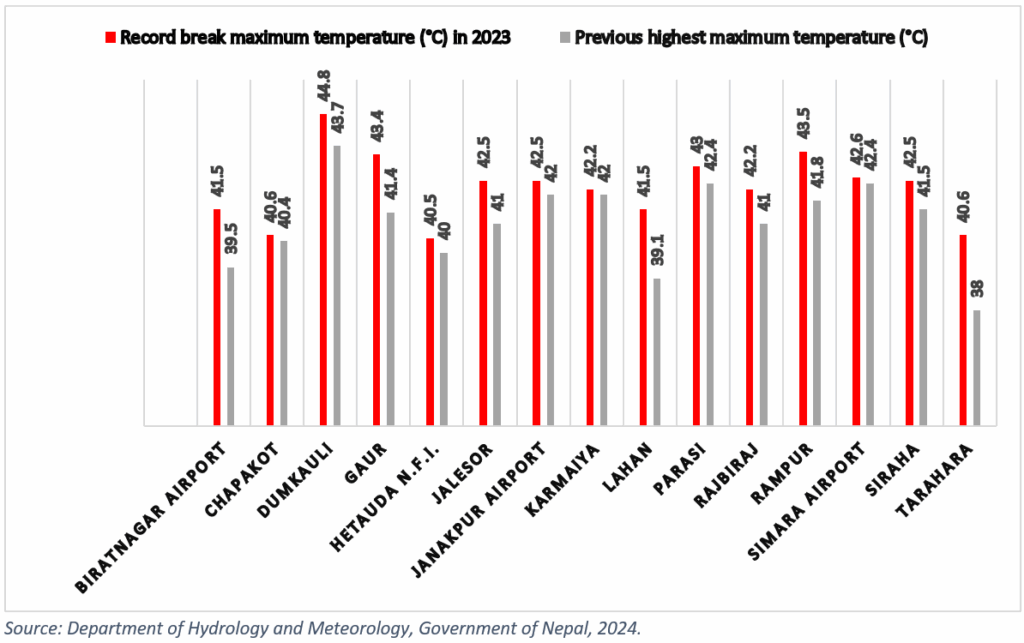
Nepal, increasingly vulnerable to climate change’s intensifying effects, confronts a significant, often overlooked threat: heatwaves. Despite being categorised as moderately at-risk, ranking 69th in vulnerability (Germanwatch 2025), the nation faces complex challenges from multiple hazards. This danger is particularly acute in its rapidly expanding urban areas, where the Urban Heat Island (UHI) effect significantly elevates temperatures, creating hazardous pockets of extreme heat that threaten public health and well-being. The escalating frequency and intensity of global heat events, coupled with observed warming trends within Nepal, underscore the urgency of developing robust heatwave mitigation strategies. As illustrated in the figure above, major cities in the Terai plains experienced unprecedented record-breaking heatwaves in 2023. The stark contrast between the red bars, representing the 2023 temperatures, and the green bars, indicating previous record highs, highlights the alarming acceleration of heat stress in the region. The Urban Heat Island (UHI) effect, caused by factors like dense land surfaces, reduced vegetation, and human-generated heat, intensifies heatwave risks in Nepal’s cities. This phenomenon renders urban populations particularly susceptible to heat stress, dehydration, and heatstroke. While some municipalities are implementing valuable greening and urban forestry initiatives (e.g., in Dhangadhi, Butwal, Chitwan, and Hetauda) to mitigate heat stress, these efforts require significant scaling up and enhanced community participation in their protection and management to achieve meaningful impact.
Several urban municipalities are taking proactive steps to mitigate heatwave impacts. For instance, Nepalgunj Sub-metropolitan City has developed a Heat Action Plan focused on seasonal risk reduction and long-term urban planning. Building on this momentum, the Climate Resilience Measurement for Communities (CRMC) is being implemented in 13 local governments, including key urban centres like Dhangadhi, Bhimdatta, and Tikapur. Evolving from the Zurich Climate Resilience Alliance’s successful Flood Resilience Measurement for Communities (FRMC), the CRMC now addresses multiple climate hazards, including heat stress and wildfires, to accelerate adaptation efforts. This data-driven process, supported by a web-based tool and mobile app, enables communities to assess their resilience, identify and implement targeted interventions, and track progress through subsequent measurements.
Given the escalating impact of heat stress in Nepal’s urban centres, the development of a timely and actionable early warning system is crucial. Leveraging the proven success of Nepal’s flood early warning systems, a robust, community-centred, end-to-end Heatwave Early Warning and Early Action System (HEWEAS) must be established. This system should feature tailored risk communication that addresses the specific needs of each community range from Terai to hill and mountain regions of Nepal. It requires a comprehensive ecosystem that integrates robust risk knowledge, advanced monitoring and prediction, effective communication strategies, and proactive preparedness measures, all coupled with enhanced community capacity at the local level.
Developing robust, community-centred Heat Early Warning and Early Action Systems (HEWEAS), alongside strengthened Local Emergency Operation Centre (EOC) response and inter-agency coordination as mandated by Nepal’s Disaster Risk Reduction and Management Act 2017, presents both challenges and significant opportunities. Crucially, Nepal can capitalise on global initiatives like Early Warning for All, implement the National Disaster Risk Reduction and Management Authority’s (NDRRMA) Strategic Action Plan for Early Warning Systems, embrace technological advancements in weather modelling and communication, leverage increasing public awareness, and build upon the nation’s inherent community resilience.
In conclusion, strengthening the capacity of Nepal’s disaster risk reduction (DRR) institutions to combat the escalating threat of heatwaves, especially within its rapidly warming urban centres, demands a paradigm shift which includes prioritising robust, community-driven HEWEAS, significantly enhancing the capacity of EOCs, and empowering local communities to take proactive measures.
Disclaimer: The views expressed in this piece are those of the author/s and do not necessarily reflect the views or policies of AIDMI.
