

Search
Or hit enter to search
By Anusha Warnasooriya, Fernando M, Hapuarchchi HASU, and Darshika, DWTT, Department of Meteorology, Colombo, Sri Lanka
Introduction
The southwest monsoon is the longest rainy season (May to September) over Sri Lanka, which begins in late May and gradually weakens in September. After the onset of monsoon, rainfall occurs in spells, and sometimes very heavy rainfall is reported over southwestern parts within 1-2 days. Lower-level wind convergence, and low-level jet (at 850hpa) and north-south oriented trough are very much prominent in deciding the strength of the rainfall events.
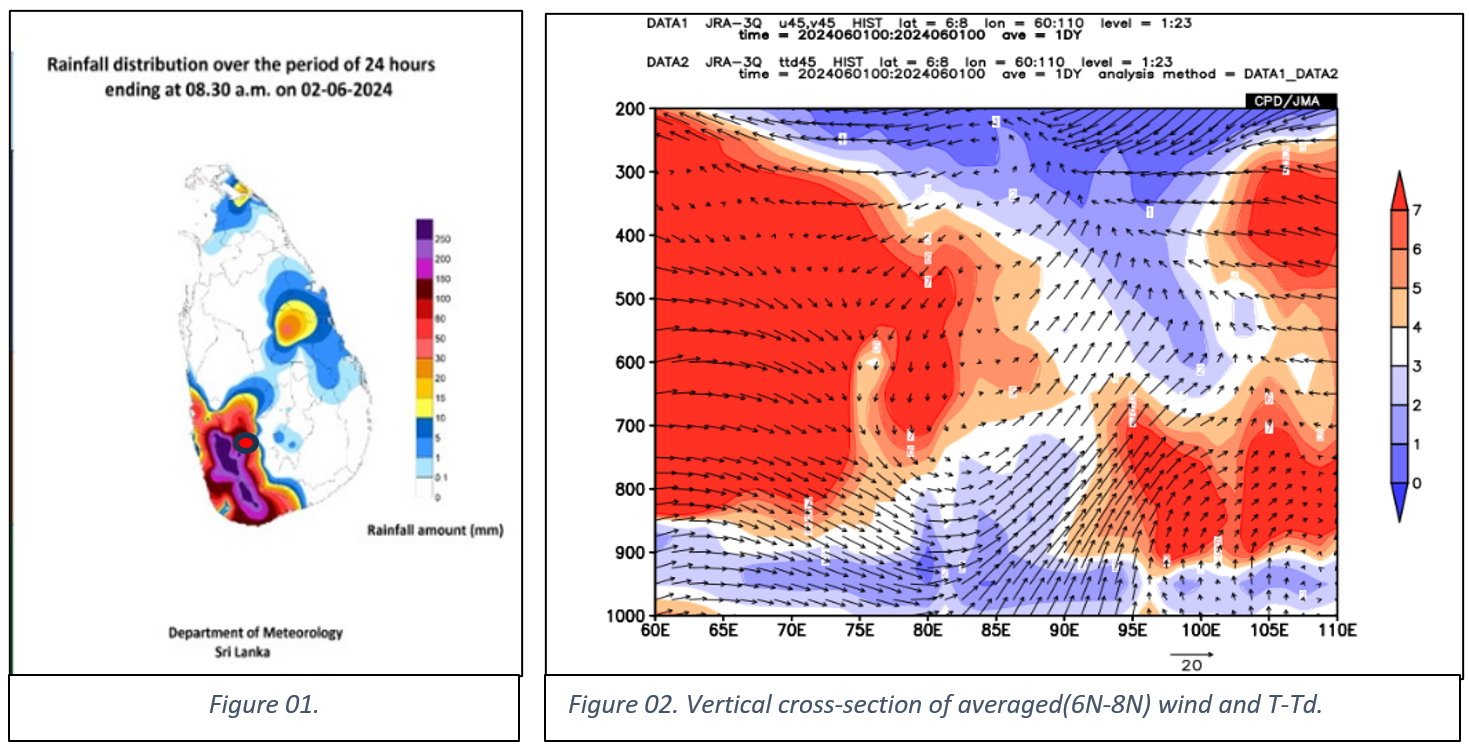
On June 01, 2024, unexpected very heavy rainfall occurred, more than 400.0 mm within 24h, at several stations in the southwestern part of Sri Lanka, causing a flood situation and affecting more than 100,000.00 people, including 16 casualties (DMC, Sri Lanka). This study is focused on analysing the synoptic situation of extremely heavy rainfall on June 01, 2024.
Methods: Synoptic observation, ERA5 and JRA-3Q reanalysis data are used to generate synoptic charts. The behaviour of the atmosphere at different levels was analysed by using ITACS software as well as GRADS. Satellite data were also analysed.
Results and Discussion
Automatic rain gauge stations’ data suggest that the rainfall rate was extremely intense (75-100 mm/hour) for a 2-hour duration at Ehaliyagoda in Rathnapura and Akurassa in Matara districts. In this heavy precipitation event, external water vapour must be quickly concentrated and constantly supplied to the area. For persistent rainstorms, water vapour is required to continue to deliver to supplement the amount of water vapour that continues to be consumed by heavy rains (Wu et al., 2023). This water vapour transport requires a particularly effective mechanism to collect the rainstorm in a much shorter period. An important fact is the persistence of the trough and the circulation pattern up to 700hpa level, sustaining the instability and continuous supply of low-level moisture that resulted in the extraordinary amount of rainfall.
Analysis showed that this extreme rainfall was associated with the interaction and the blocking of the Atmospheric River (AR) by a north–south-oriented low-level deep trough extending up to 850 hpa level along with an east-west-oriented trough axis at 700 hpa over Sri Lanka. Favourable vertical wind shears up to 500 hpa, lower-level horizontal wind shear, and 200 hpa divergence also enhanced the instability. Further, a deep moisture gradient similar to the dry line over the SW part also triggered this high-intense rainfall from 11.00 p.m. on 1 June to 01.00 a.m. on 2 June 2024. Figure 02 shows the vertical cross-section of the averaged wind and T-Td. It shows continuous moisture flow through the lower troposphere, an Atmospheric River, coming towards 80E, the southwestern part of Sri Lanka, from the Arabian Sea. It also clearly shows the blocking of moisture flow around 81E-82E. It depicted dry atmospheric conditions at the 850 hpa level.
Conclusion
The blocking of lower-level AR coming from the Arabian Sea on 1 June 2024, by a deep lower-level trough, provided a large amount of continuous moisture supply to the middle part of the SW region and enhanced instability by a deep moisture gradient (like a dry line). The upper-level divergence and vertical and horizontal windshear provided by mid and upper tropospheric easterlies resulted in exceptionally heavy rainfalls over the Southwestern region.
Acknowledgement: For the European Centre for Medium Range Weather Forecasting and Japan Meteorological Agency for providing reanalysis data.
Disclaimer: The views expressed in this piece are those of the author/s and do not necessarily reflect the views or policies of AIDMI.
