Search
Or hit enter to search
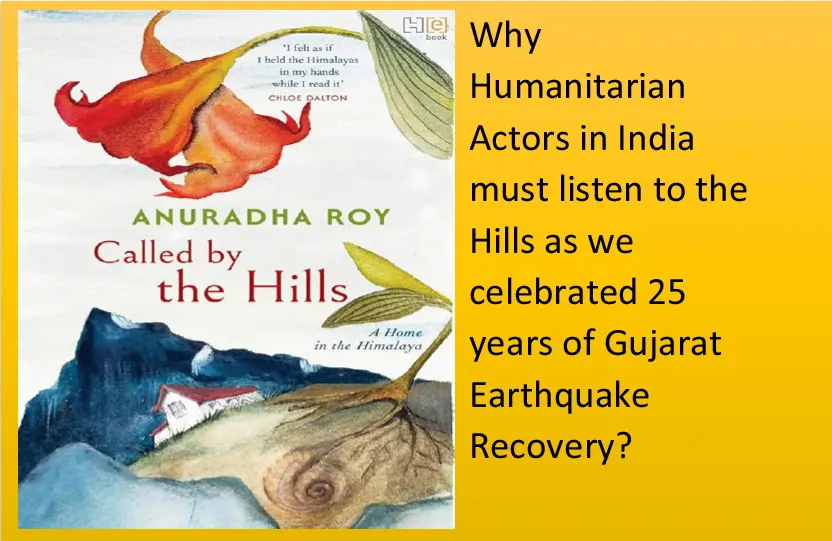
As we commemorated 25 years of recovery from the Gujarat Earthquake, it is important to reflect not only on past achievements but also on future risks. Scientific understanding and lived experience both point to India’s Himalayan region as a zone of increasing vulnerability—exposed to earthquakes, landslides, extreme weather, and climate-induced stresses. In this context, Called by the Hills by Anuradha Roy offers timely and meaningful reflections for humanitarian action in India, around earthquake risk and beyond.
Roy’s book invites readers to see the hills, but also applicable to landscapes of any risk, not as distant or romantic landscapes, but as fragile, inhabited spaces shaped by memory, endurance, and continuous negotiation with nature. From remote mountain paths to everyday village life, the hills emerge as living systems where ecology and humanity are deeply intertwined. For humanitarian actors, this reinforces the need for disaster risk reduction and climate adaptation strategies that are ecology-sensitive, locally rooted, and sustained over time.
A key value of the book to India’s humanitarian workers lies in its attention to invisible vulnerabilities. Social isolation, outmigration, ageing populations, loss of connectivity, and weakening community support systems. These vulnerabilities often remain outside formal assessments, yet they determine how disasters are experienced and how recovery unfolds. Humanitarian action must therefore move beyond infrastructure and assets to engage with social fabric, dignity, and emotional well-being.
Equally important is Roy’s resistance to the outsider’s urge to “fix” the hills. Instead, the book offers an ethical reminder: listening must come before intervention. Communities possess deep ecological knowledge, cultural practices, and coping strategies that are essential for addressing risks such as landslides, earthquakes, cold waves, and displacement. Respecting this knowledge strengthens both preparedness and recovery.
Finally, Called by the Hills challenges simplified narratives of resilience by revealing its emotional costs. Endurance should not be romanticised or taken for granted. Humanitarian responses must therefore be trauma-informed, culturally respectful, and humane—recognising strength without normalising suffering of the poor and vulnerable.
For AIDMI, these reflections resonate strongly with decades of experience in disaster recovery and risk reduction. As India faces new and complex risks, listening to the landscapes of risks is not optional—it is essential for just, effective, and sustainable humanitarian action, now on.