Search
Or hit enter to search
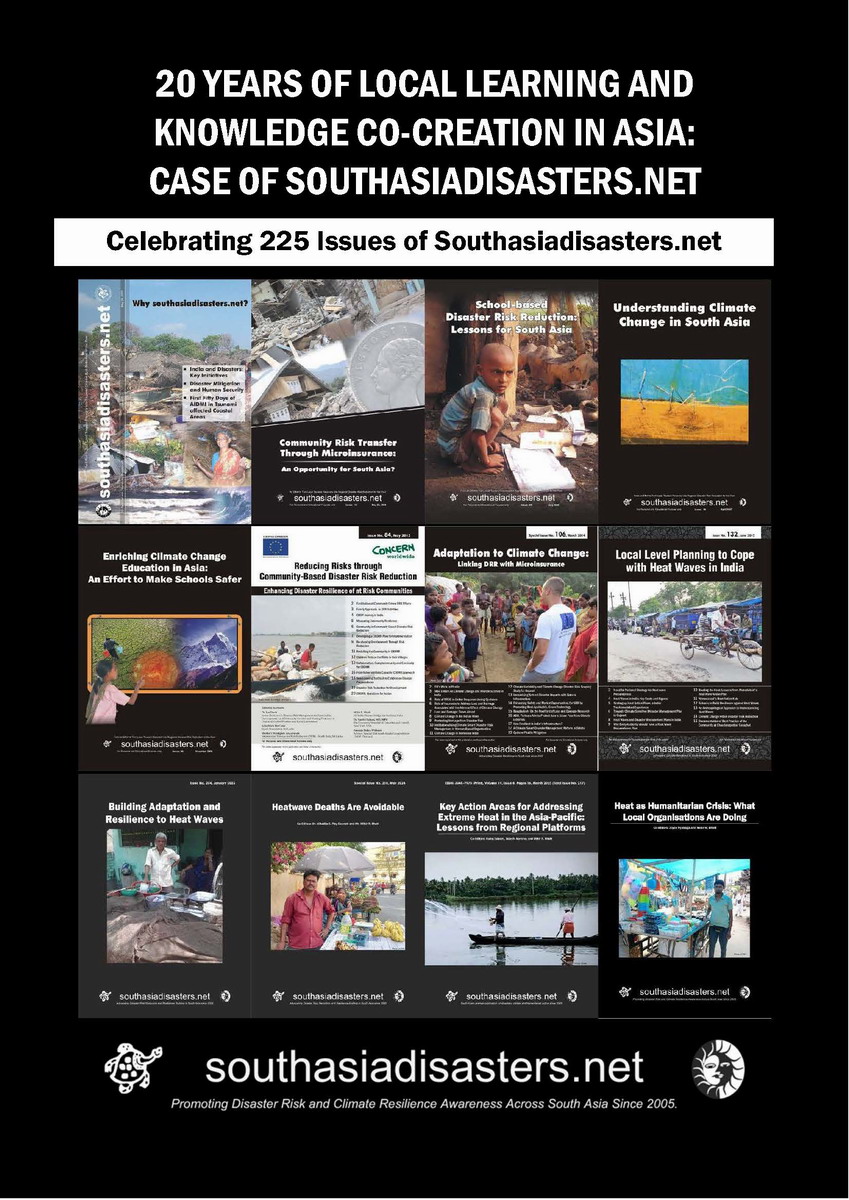
Southasiadisasters.net, Issue No. 225 | October 2025
In partnership with ADRRN and ALNAP, the session titled “20 Years of Local Learning and Knowledge Co-Creation in Asia: The Case of Southasiadisasters.net” marked the formal launch by AIDMI of the milestone 20-year retrospective edition of Southasiadisasters.net (Issue 225), further strengthening this uniquely community-rooted humanitarian knowledge archive at the Regional Humanitarian Partnership Week (RHPW) Asia Pacific 2025 in Bangkok on December 10, 2025. Read more
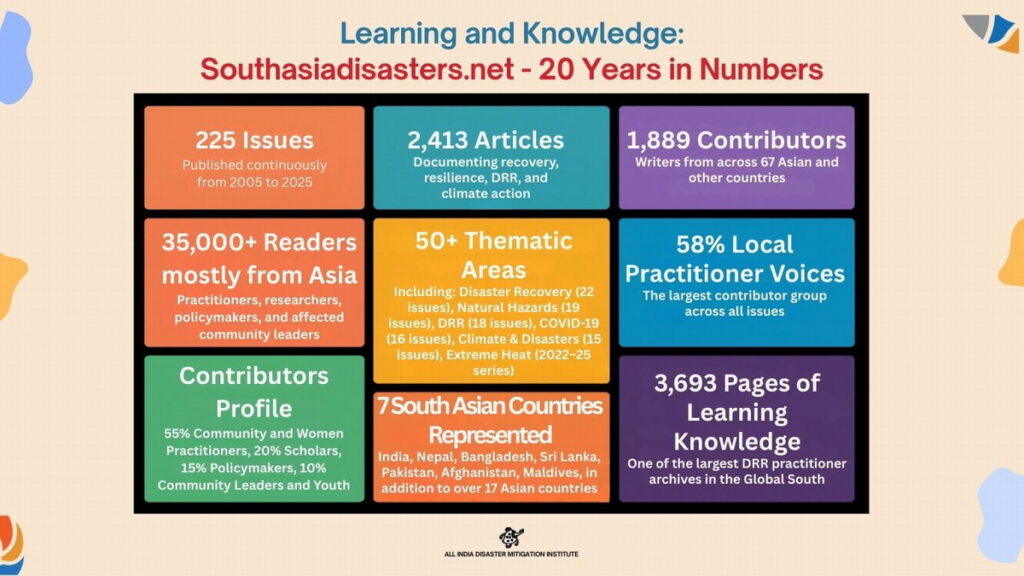
For two decades, Southasiadisasters.net has been a trusted voice for resilience across South Asia—bringing together over 1,800 contributors from 67 countries and documenting more than 2,400 articles of field learning, policy insight, and community innovation. Now in its 225th issue, the publication continues to bridge local experience with global frameworks, turning stories from the ground into shared lessons for humanitarian action, disaster risk reduction, and climate resilience. From extreme heat and urban risk to early warning systems and inclusive recovery, Southasiadisasters.net stands as one of the most enduring knowledge platforms of the Global South—amplifying voices that matter and strengthening resilience where it begins: with communities.
In This Issue:
SECTION I: FOUNDATIONS, PURPOSE, AND LEGACY
Mihir R. Bhatt, All India Disaster Mitigation Institute, India
AIDMI Team, India
Krishna S. Vatsa, National Disaster Management Authority (NDMA), Government of India, India
Sujan Mandal, Suchismita Roy, Dr. P.G. Dhar Chakrabarti, Ramakrishna Mission Vivekananda Educational and Research Institute, Kolkata, India
Dr. Mrutyunjay Mohapatra, India Meteorological Department (IMD), India
Sanjaya Bhatia, UN Office for Disaster Risk Reduction (UNDRR), Republic of Korea
Zenaida Delica-Willison, Special Unit South-South Cooperation in UNDP, Thailand
SECTION II: AIDMI’S VISION AND STRATEGIC FRAMEWORKS
SECTION III: REGIONAL, SOUTH–SOUTH, AND GLOBAL PERSPECTIVES
Takeshi Komino, ADRRN Chairperson, Japan
Dr. Ian Davis, Global Leader on DRR, UK
Dr. Denis Nkala, South-South Cooperation and United Nations Development Programme, USA
Dr. Jennifer Doherty, ALNAP, United Kingdom
Paul Knox Clarke, ADAPT Initiative, United Kingdom
JC Gaillard, University of the Philippines Resilience Institute, New Zealand
Lorenzo Guadagno, Platform on Disaster Displacement Secretariat, Switzerland
SECTION IV: LEARNING, TEACHING, AND KNOWLEDGE COMMUNITIES
Ilan Kelman, Professor of Disasters and Health, University College London
Abha Mishra, Regional Office (Eastern & Central), United Nations Development Programme, Odisha, India
SECTION V: COUNTRY EXPERIENCES AND INCLUSIVE RESILIENCE
Anoja Seneviratne, Disaster Management Centre, Sri Lanka
Madhavi Malalgoda Ariyabandu, Senior Expert, Disaster and Climate Risk, Sri Lanka
Dr. Md. Shahid Uz Zaman, Eco-Social Development Organization (ESDO), Dhaka, Bangladesh
Dr. Hippolyte Traoré, Ministry of Health and Social Development, Bamako, Mali
Muhammad Taher, Duryog Nivaran, Bangladesh
A.R.P.Warnasooriya, Department of Meteorology, Sri Lanka
SECTION VI: KNOWLEDGE PRACTICE, RESEARCH, AND COMMUNITY NARRATIVES
Dr. Prerna Singh, Transitions Research, India
Subir Dey, Assistant Professor in History, Azim Premji University, Bengaluru, India
Dr. Shakuntala Pratihary, Centre for Research and Community Action (CeRCA), India
Dr. Shashi Ram, Telangana, India
Prajakta Pimpalshende, CSIR-NEERI, Maharashtra, India; Shalini Dhyani, Academy of Scientific and Innovative Research (AcSIR), Uttar Pradesh, India
Manish Patel, AIDMI, India
SECTION VII: SYSTEMS STRENGTHENING AND THE WAY FORWARD