Climate Resilience | 14 Aug, 2026
Heat-Resilient Infrastructure: Lessons from Emerging Global Experience
Southasiadisasters.net, Issue No. 232 | July 2026
“The real test of heat-resilient infrastructure is not how strong it looks on paper, but whether it keeps the most exposed people safe, healthy, and able to continue their lives with cool dignity.”
— Mihir R. Bhatt, All India Disaster Mitigation Institute (AIDMI), India
The latest issue of Southasiadisasters.net focuses on “Heat-Resilient Infrastructure: Lessons from Emerging Global Experience”. This issue brings together field experiences, policy perspectives, community voices, and practical lessons on how infrastructure can better protect people from rising extreme heat.
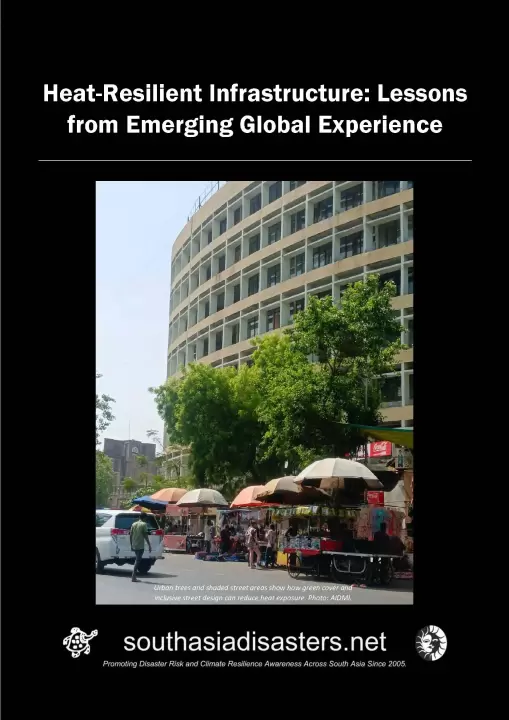
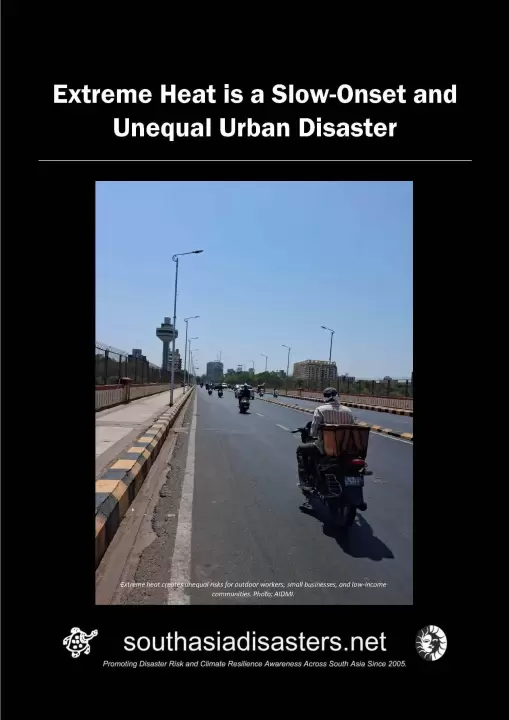
Extreme heat is increasingly affecting housing, schools, hospitals, roads, railways, water systems, power networks, public transport, markets, and everyday livelihoods. The issue highlights that heat-resilient infrastructure must keep essential services functioning when people need them most, especially women workers, children, older persons, small businesses, informal workers, low-income households, and communities living in vulnerable settlements.
In This Issue:
- What Lessons from Past Long-term Recovery after Earthquakes and Floods Help Plan for Extreme Heat in India?
Dr. Mittul Vahanvati, Program Manager and Senior Lecturer, School of Global Urban and Social Studies, RMIT University, Melbourne, Australia
- Strengthening Heat Governance and Heat Action Plan Implementation in India
Jorge Gastelumendi, Senior Director, Climate Resilience Center, Atlantic Council, United States
- Humanitarian Leadership for Slow-Onset Urban Heat Crises
Dr. Jamie Munn, Executive Director, International Council of Voluntary Agencies (ICVA), Switzerland
- Risks to Critical Infrastructure due to Extreme Heat
Ramraj Narasimhan, Senior Director, Programme Management and Technical Support, Coalition for Disaster Resilient Infrastructure (CDRI), India
- Locating Water in the Heat Action Plan
Shiny Saha, Senior Programme Officer, International Water and Sanitation Centre (IRC WASH), South Asia Hub, India
- Urban Heat Action Plans: Progress, Gaps, and Priorities for Protecting Vulnerable Groups of India
Abhiyant Tiwari and Anshima Mishra, NRDC India
- कच्छ की महिलाएँ और हीट रेजिलिएंस के सबक (Women of Kutch and Lessons for Heat Resilience)
Lata Sachdev, Kutch Mahila Vikas Sangathan (KMVS), Gujarat, India
- Old Trees, Green Cover, and Urban Cooling: Nature-Based Infrastructure for Heat Resilience
Dr. Deepa Gavali, Executive Secretary, Gujarat Ecology Society, and Dr. Jitendra Gavali, Botanist, Vadodara, Gujarat, India
- Cooling, Housing Design, and Thermal Comfort: Applying Recovery Lessons to Urban Heat Resilience
AIDMI Team, India
- Can Assam’s Cities Beat the Heat? The Role of Green and Blue Infrastructure
Rituraj Neog, Assistant Professor, Department of Geography, Gargaon College, Simaluguri, Assam, India; and Shukla Acharjee, Assistant Professor, Department of Geography & Centre for Atmospheric Studies, Dibrugarh University, Dibrugarh, Assam, India
- Making Heat Visible: From Preparedness to Resilience
Uttam Pudasaini, Director, Climate and DRR Technology Department, and Kundan Jung Thapa, Programme Coordinator, Urban Informatics Department, NAXA, Kathmandu, Nepal
- Continuing Business in Extreme Heat: Jashiben’s Story of Heat Adaptation
Pallavi Rathod, All India Disaster Mitigation Institute (AIDMI), India
- Making Heat-Resilient Infrastructure People and Nature Centred
Mihir R. Bhatt, All India Disaster Mitigation Institute (AIDMI), India
Write for the upcoming Southasiadisasters.net. Share your insights and experience on heat, health, and livelihood resilience. To contribute, write to knowingrisk@aidmi.org.