Search
Or hit enter to search
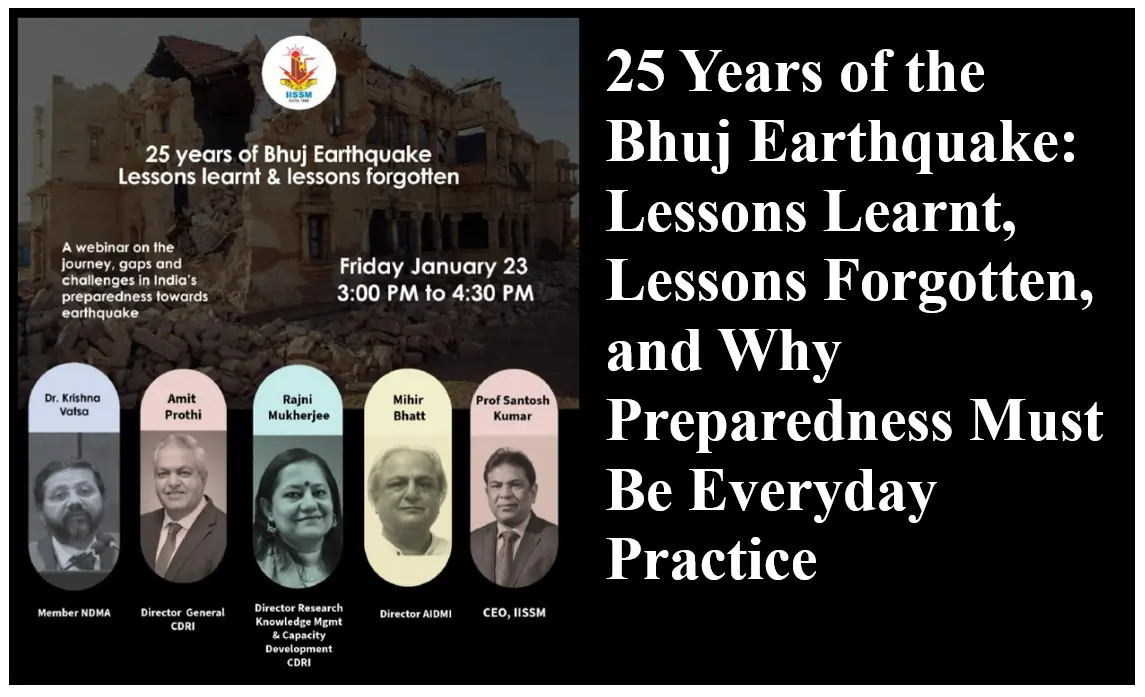
The Bhuj earthquake of 26 January 2001 marked a defining moment in India’s disaster risk and recovery journey that became clear after the Odisha cyclone of 1999. Twenty-five years later, reflections from the webinar “25 Years of the Bhuj Earthquake: Lessons Learnt and Lessons Forgotten” by the International Institute of Safety and Security Management (IISSM) on January 23, 2026, with a panel of Dr. Krishna S. Vatsa, Ms. Ranjani Mukherjee, Prof. Santosh Kumar, and Mr. Mihir R. Bhatt reaffirm that while India has progressed significantly, preparedness remains an ongoing responsibility.
Since Bhuj, India has strengthened its disaster governance systems through improved seismic monitoring, revised zoning regulations, expanded earthquake engineering education, and the establishment of robust national and state disaster management frameworks. These advances reflect a decisive move away from response-only approaches toward long-term mitigation and preparedness.
However, discussions emphasised that preparedness must become an everyday practice. Bhuj demonstrated that resilience grows over time when risk reduction is embedded in daily governance, infrastructure planning, livelihoods, and local institutions such as schools and hospitals. Community-centred recovery in Gujarat showed that sustained engagement—rather than short-term consultation—creates durable outcomes and real impact.
Economic recovery emerged as a critical pillar of resilience. Restoring livelihoods, supporting small businesses, and protecting informal workers were identified as essential to long-term recovery. When risk reduction is linked to everyday concerns such as housing safety, schools, infrastructure services, and income continuity, preparedness becomes relevant and actionable.
Despite progress, persistent challenges remain. Retrofitting existing buildings, improving compliance with building codes, strengthening rural infrastructure, and safeguarding critical systems require sustained investment and institutional commitment—especially as urbanisation accelerates.
Bhuj’s greatest legacy lies not only in rebuilt structures but in institutional learning, skills development, and the recognition that preparedness is continuous. As India moves toward Viksit Bharat 2047, remembering Bhuj means acting on its lessons—every day, at every level, by every citizen.