Donate
Co-creating Knowledge | 25 Sep, 2026
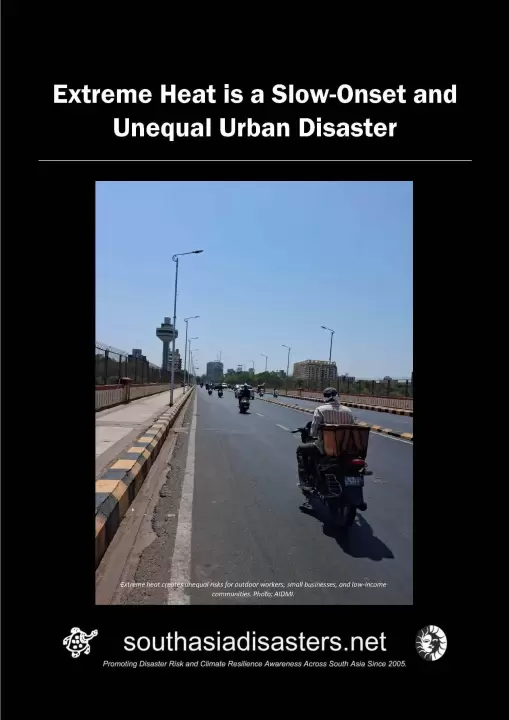
Extreme Heat is a Slow-Onset and Unequal Urban Disaster

Southasiadisasters.net, Issue No. 233 | August 2026


“Heat justice must begin where heat risk is highest — with workers, women, children, commuters, migrants, and low-income communities who carry the greatest burden but have the least protection.”
– Mihir R. Bhatt, All India Disaster Mitigation Institute (AIDMI), India


The latest issue of Southasiadisasters.net focuses on “Extreme Heat is a Slow-Onset and Unequal Urban Disaster.” The issue highlights how extreme heat creates unequal risks for outdoor workers, small businesses, and low-income communities.

Extreme heat is no longer only a seasonal weather concern. It is a slow-onset and unequal urban disaster that affects health, livelihoods, productivity, water access, sleep, mental wellbeing, mobility, housing, and local economies. Unlike floods or cyclones, heat often builds quietly over time, and its impacts remain less visible but deeply damaging.

This issue brings together field evidence, policy reflections, community voices, and practical lessons on heat action, social investment, worker protection, anticipatory action, citizen-led monitoring, and community heat resilience.


In this Issue

  1. Mobilising Social Investment for Urban Heat Resilience in Asia: Reflections from the AVPN Climate x Health Community of Practice
    Melissa Ananthraj, Director, Programs, Climate Action, AVPN, Asia
  2. The Mind in the Heat: Mental Health Among Ahmedabad’s Mobility Workforce
    Rohan Trivedi, AIDMI, India
  3. Extreme Heat and Unequal Risks for Workers
    Sharon Block, Professor of Practice, Executive Director, Center for Labor and a Just Economy, Harvard Law School, United States
  4. Participatory Knowledge and Extreme Heat: Strengthening People-Centred Local Urban Resilience
    Piyush Poddar, Lead-Programmes, Martha Farrell Foundation, New Delhi, India
  5. Extreme Heat as a Slow-Onset and Unequal Urban Disaster
    Jyoti Mackwan, General Secretary, SEWA, India
  6. Extreme Heat and Equitable Anticipatory Action: Progress and Challenges in Communities of India
    Santhosh Srikanth Pattar, Country Director, ADRA India
  7. अत्यधिक गर्मी: धीमी और असमान शहरी आपदा
    AIDMI Team, India
  8. Heat Inequity in Mumbai: A Silent, Invisible Public Health Crisis Among Urban Poor
    Nidhi Jamwal, Climate Journalist, Mumbai, India
  9. Extreme Heat and Priority Areas for Building Equal Resilience in India
    Priyanka Thirumurthy, Head of Communications, Asar Social Impact Advisors, Karnataka, India
  10. HeatWatch and Citizen-Led Monitoring: Making Urban Heat Inequality Visible
    Ananya Tiwary and Apekshita Varshney, Project Associate, HeatWatch, Maharashtra, India
  11. Citizen Power for Community Heat Resilience: Small Businesses Taking Collective Action
    Pallavi Rathod, AIDMI, India
  12. Active Heat Justice Must Shape Urban Resilience
    Mihir R. Bhatt, AIDMI, India

Write for the upcoming Southasiadisasters.net. Share your insights and experience on heat, health, and livelihood resilience. To contribute, write to knowingrisk@aidmi.org.

Connect with the All India Disaster Mitigation Institute (AIDMI) and subscribe for updates on upcoming events, publications, and initiatives.
Explore Similar Content

Subscribe to Our Newsletter

Join our mailing list to stay up to date on all
The latest news and events from AIDMI

Subscribe to our Newsletter!