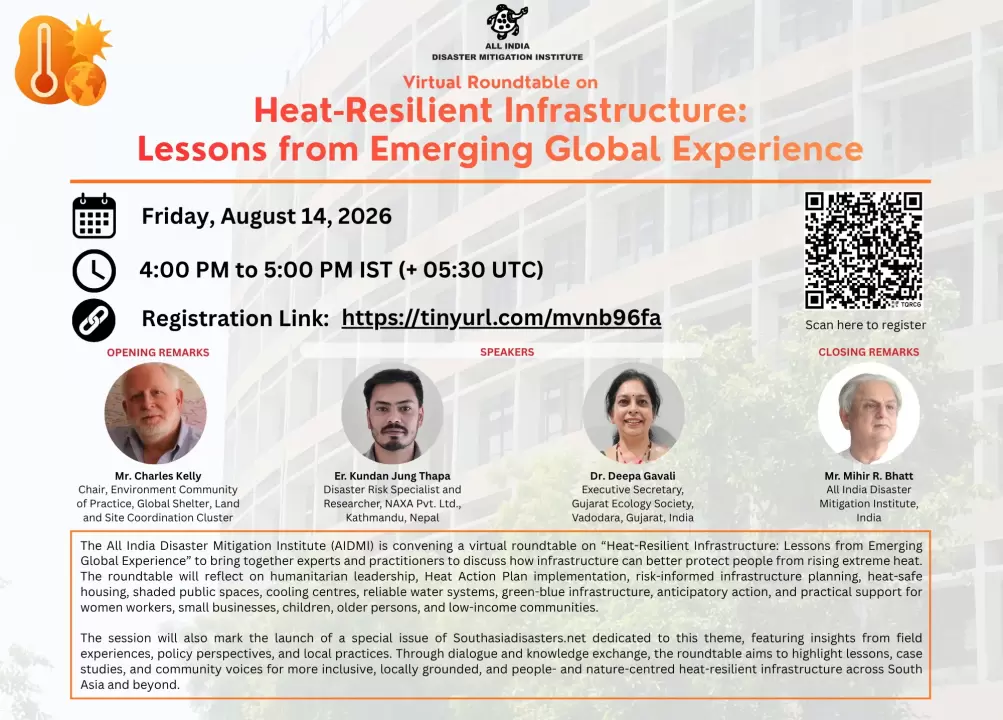
📅 Date: Friday, August 14, 2026
🕓 Time: 04:00 PM to 05:00 PM IST
Organised by: All India Disaster Mitigation Institute (AIDMI)
💬 About the Roundtable
The All India Disaster Mitigation Institute (AIDMI) convened a virtual roundtable on “Heat-Resilient Infrastructure: Lessons from Emerging Global Experience” on Friday, August 14, 2026.
The roundtable brought together experts, practitioners, researchers, and community-focused organisations to discuss how infrastructure could better protect people from increasing extreme heat.
The discussion focused on humanitarian leadership, Heat Action Plan implementation, risk-informed infrastructure planning, heat-safe housing, shaded public spaces, cooling centres, reliable water systems, green-blue infrastructure, anticipatory action, and practical support for women workers, small businesses, children, older persons, and low-income communities.
📘 Launch of a Special Issue
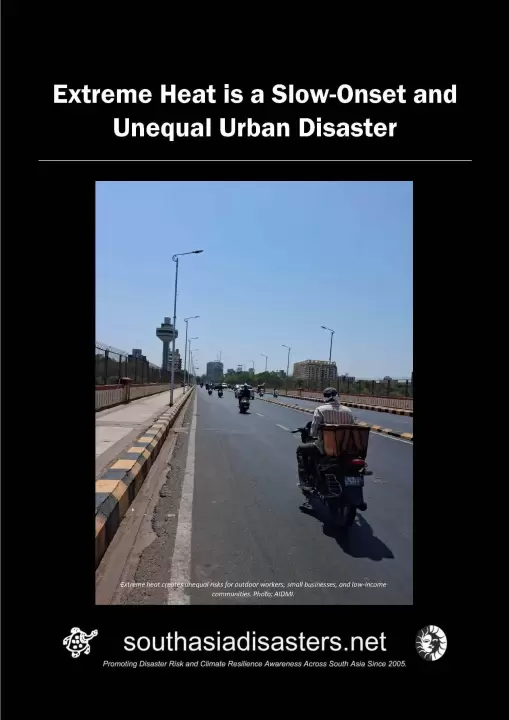
The session also marked the launch of a special issue of Southasiadisasters.net dedicated to this theme, featuring insights from field experiences, policy perspectives, community voices, and local practices. Through dialogue and knowledge exchange, the roundtable highlighted more inclusive, locally grounded, and people- and nature-centred approaches to heat-resilient infrastructure across South Asia and beyond.
To exchange practical lessons on heat-resilient infrastructure from South Asia and emerging global experience.
To discuss how infrastructure could protect health, livelihoods, dignity, and essential services during extreme heat.
To strengthen dialogue on Heat Action Plan implementation, local preparedness, green-blue infrastructure, and community-centred adaptation.
💬 Key Discussion Areas:
Humanitarian Leadership and Heat Governance: The discussion explored ways to strengthen preparedness, coordination, and accountability for extreme heat risks and urban heat crises.
Heat-Resilient Infrastructure and Essential Services: Participants discussed approaches to protecting housing, schools, hospitals, transport systems, water systems, cooling centres, and public spaces during heatwaves.
Community-Centred and Nature-Based Heat Resilience: The roundtable explored shaded streets, old trees, green-blue infrastructure, heat-safe livelihoods, and practical support for women workers, small businesses, and vulnerable communities.
🎤 Speakers:
Mr. Charles Kelly, Chair, Environment Community of Practice, Global Shelter, Land and Site Coordination Cluster
Er. Kundan Jung Thapa, Disaster Risk Specialist and Researcher, NAXA Pvt. Ltd., Kathmandu, Nepal
Dr. Deepa Gavali, Executive Secretary, Gujarat Ecology Society, India
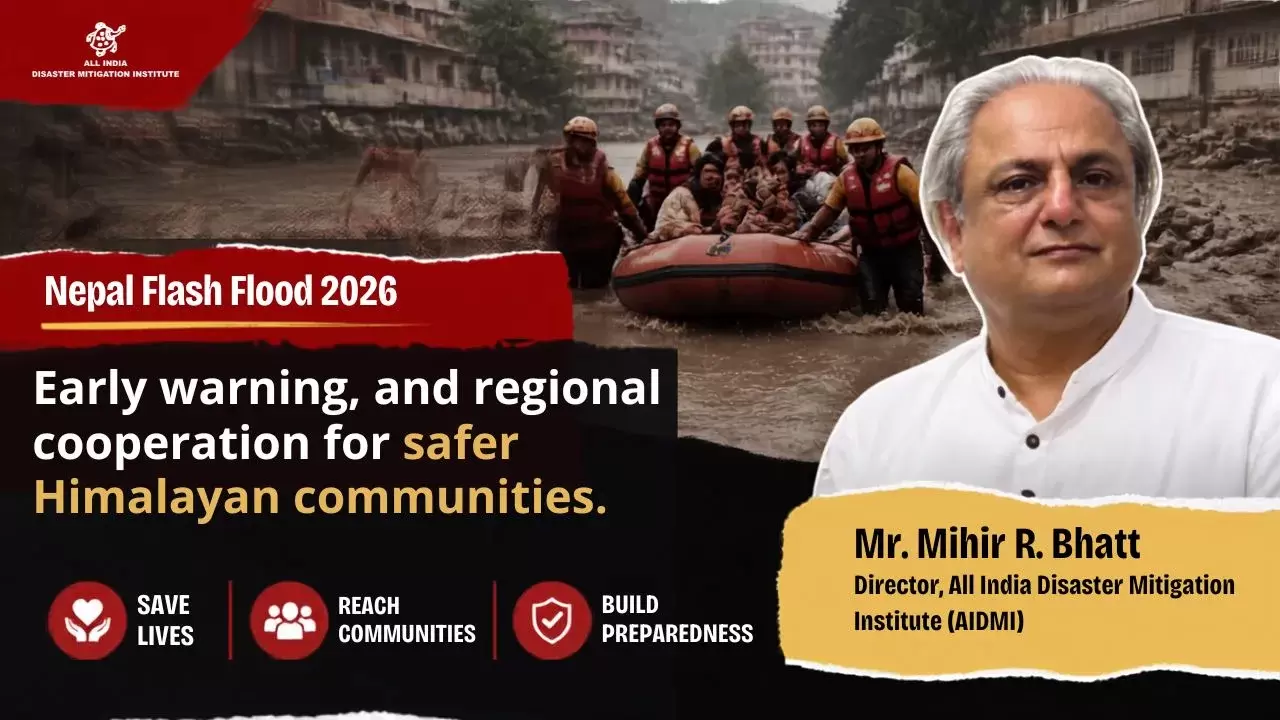
Mr. Mihir R. Bhatt, All India Disaster Mitigation Institute, India
📢 The roundtable explored how heat-resilient infrastructure could protect health, livelihoods, essential services, and dignity for communities most exposed to extreme heat, including women workers, small businesses, informal settlements, children, older persons, and low-income households. It also created an opportunity for participants to exchange experiences, identify practical actions, and strengthen collaboration on heat-resilient infrastructure.
Connect with the All India Disaster Mitigation Institute (AIDMI) and subscribe for updates on upcoming events, publications and initiatives.
Speakers
Deepa Gavali
Executive Secretary, Gujarat Ecology Society, Gujarat, India
Short Bio
Deepa Gavali
Executive Secretary, Gujarat Ecology Society, Gujarat, India
Dr. Deepa Gavali is associated with Gujarat Ecology Society, Vadodara, Gujarat, India, and works on ecology, biodiversity, urban green cover, nature-based solutions, and climate resilience.
Kundan Jung Thapa
Disaster Risk Specialist and Researcher, NAXA Pvt. Ltd., Kathmandu, Nepal
Short Bio
Kundan Jung Thapa
Disaster Risk Specialist and Researcher, NAXA Pvt. Ltd., Kathmandu, Nepal
Er. Kundan Jung Thapa is a Disaster Risk Specialist, researcher, and civil engineer with expertise in geospatial technologies for climate change, urban resilience and disaster risk reduction. As Program Lead at NAXA Pvt. Ltd., he leads multidisciplinary initiatives that combine GIS, remote sensing, satellite imagery, field assessments, and digital platforms to strengthen anticipatory action and climate adaptation. His recent work includes developing heat hotspot analyses, heat-health risk assessments, and GIS-based decision-support systems for the IFRC, American Red Cross, ADPC, and local governments across Nepal. His research and practice focus on translating complex spatial data into actionable insights that support resilient infrastructure planning, heat action planning, and evidence-based public investment.
Charles Kelly
Chair, Environment Community of Practice, Global Shelter, Land and Site Coordination Cluster
Short Bio
Charles Kelly
Chair, Environment Community of Practice, Global Shelter, Land and Site Coordination Cluster
Mr. Kelly has been involved in international disaster risk management for over 40 years, including work in countries spanning the Caribbean, Latin America, Europe, Africa and Asia. His work has involved disaster preparedness and response, recovery, early warning and risk reduction. In recent years, he has been a humanitarian sector focal point for environmental issues and currently serves as the Secretariat for the Extreme Heat Working Group of the Global Shelter, Land and Site Coordination Cluster.
Mihir R. Bhatt
Director, AIDMI
Short Bio
Mihir R. Bhatt
Director, AIDMI
Mihir R. Bhatt leads AIDMI. His work connects disaster risk reduction, extreme heat, early warning, climate resilience, nature, and livelihoods, with a particular focus on affected populations, small businesses, and locally led action in India.
All India Disaster Mitigation Institute (AIDMI) is a non-profit organization established and registered as a Public Trust under The Bombay Public Trusts Act, 1950, under the registration number F/5007Ahmedabad.