Search
Or hit enter to search
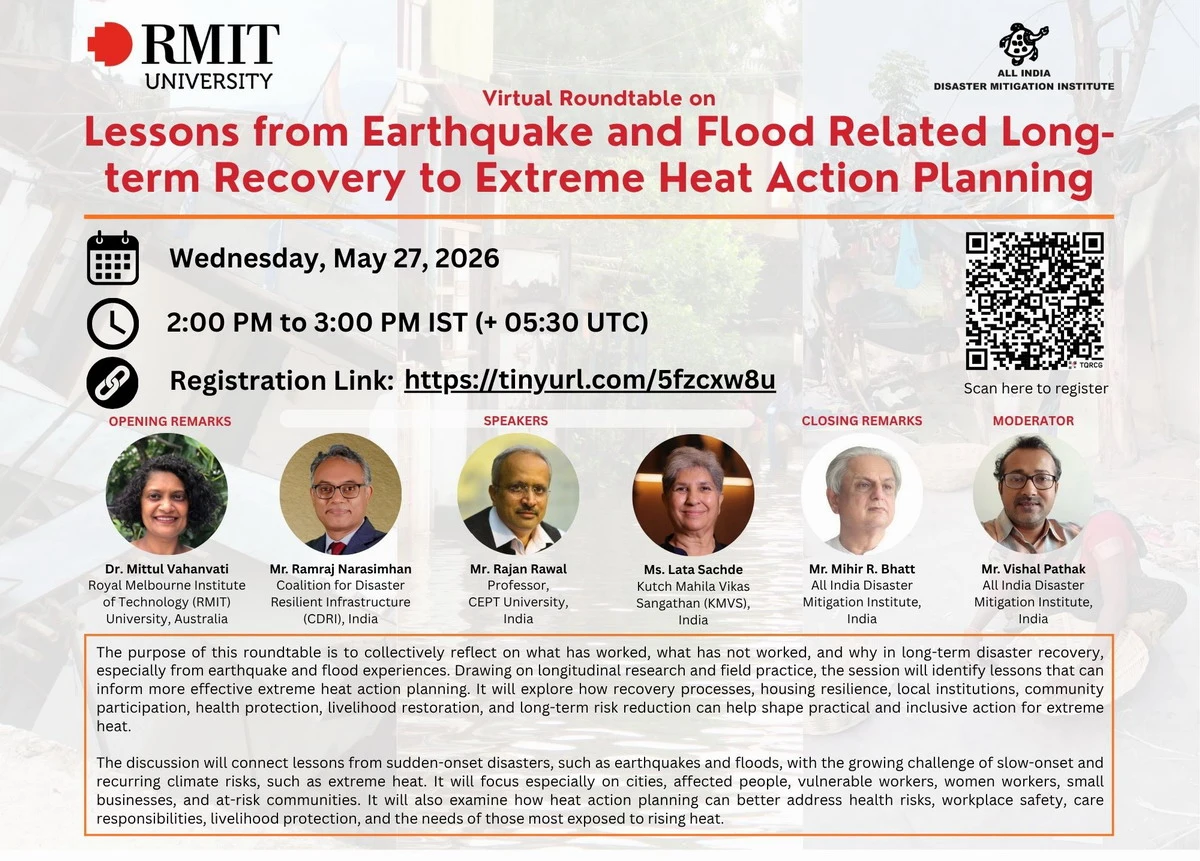
See Recording: https://www.youtube.com/watch?v=kU8kRhqBzXQ
Date: Wednesday, May 27, 2026
Time: 2:00 PM to 3:00 PM IST (+ 05:30 UTC)
Organised by: All India Disaster Mitigation Institute (AIDMI) and Royal Melbourne Institute of Technology (RMIT) University
The All India Disaster Mitigation Institute (AIDMI) and the Royal Melbourne Institute of Technology (RMIT) University convened a virtual roundtable on “Lessons from Earthquake and Flood Related Long-term Recovery to Extreme Heat Action Planning” on Wednesday, May 27, 2026, from 2:00 PM to 3:00 PM IST. The roundtable brought together representatives from government, international organisations, academia, and civil society.
The purpose of this roundtable was to collectively reflect on what had worked, what had not worked, and why in long-term disaster recovery, especially from earthquake and flood experiences. Drawing on longitudinal research and field practice, the session identified lessons that could inform more effective extreme heat action planning. It explored how recovery processes, housing resilience, local institutions, community participation, health protection, livelihood restoration, and long-term risk reduction could help shape practical and inclusive action for extreme heat.
The discussion connected lessons from sudden-onset disasters, such as earthquakes and floods, with the growing challenge of slow-onset and recurring climate risks, such as extreme heat. It focused especially on cities, affected people, vulnerable workers, women workers, small businesses, and at-risk communities. The roundtable also examined how heat action planning could better address health risks, workplace safety, care responsibilities, and livelihood protection for those most exposed to rising heat.
🎯 Key Objectives
💬 Key Discussion Areas
🎤 Speakers
📢 The roundtable explored how learning from long-term earthquake and flood recovery could inform more inclusive, practical, and locally grounded extreme heat action planning for cities, communities, women workers, vulnerable workers, small businesses, and at-risk groups.